The top Google result for "product tour software" is a Reddit thread — a signal that buyers in this category trust peers over vendor blogs.
The analysis below covers eleven tools across five buyer categories: bootstrapped SaaS, growing SaaS (Series A–B), enterprise, sales-led, and developer-heavy. Pricing is aggregated across vendor pricing pages as of May 2026. Where sources disagree, both numbers appear.
Methodology
Most listicles in this category have one of two problems. Either they are written by a vendor that places itself at #1 (Userpilot, Appcues, and Navattic all do this on their own roundups), or they are written by a content marketer who has not shipped onboarding to a SaaS product and the post reads like it.
Each tool below is rated against five criteria that determine whether a team will still be using it six months later:
- Pricing transparency. Is the real number visible before talking to sales? "Custom quote" usually means $25K+ per year, paid upfront.
- Time to first published tour. From signup to a live tour in production — hours or days?
- Buyer fit. Bootstrapped founder, mid-market PMM, or enterprise CS lead. Tools that try to serve all three are typically worst at the one closest to the reader.
- Code vs no-code reality. Most tools advertise "no code." A few actually deliver it. A few benefit from a developer in the loop.
- Scaling behavior. Per-MAU pricing means product growth increases the bill linearly. Flat pricing does not punish growth. Custom contracts mean an annual renewal conversation.
Pricing was checked against each vendor's current pricing page on May 18, 2026 — live captures embedded throughout. Transparency in this category varies more than competing roundups suggest. StepsKit, UserGuiding, Userpilot, Supademo, Chameleon, Navattic, and Userflow all publish at least one dollar amount on their own pricing page. Pendo publishes a Free tier and gates its three paid tiers behind a sales call. Appcues, WalkMe, and Whatfix publish no dollar amounts at all — every tier is "Book a demo" or "Request a quote." Where a number appears in this post, it came from the vendor's own page on May 18, 2026. Where a vendor's number is missing, the post says so explicitly rather than substituting older third-party estimates as fact.
The five categories that actually matter
"Best product tour software" is a meaningless ranking on its own. A bootstrapped solo founder shipping the first onboarding flow has nothing in common with a CS team at a 5,000-employee fintech rolling out compliance training to 50,000 internal users. The tools are different by design.
| Category | Who it fits | Tools that match |
|---|---|---|
| Bootstrapped & early-stage | Solo founders, pre–Series A teams, under ~$500/mo budget | StepsKit, UserGuiding (entry tier), Supademo |
| Growing SaaS | Series A to early Series B, dedicated PMM, $300–$1,500/mo budget | Appcues, Chameleon, Userpilot |
| Enterprise | Series B+, custom contracts, compliance, multi-product orgs | Pendo, WalkMe, Whatfix |
| Sales-led / interactive demos | Sales teams that demo the product before signup | Navattic |
| Developer-heavy | Engineering-owned onboarding, component-level control | Userflow, StepsKit |
If a category does not describe the reader, its tools are not "worse." They are built for someone else. The fastest cost-of-mistake in this category is paying mid-market pricing (typically $700–$1,500/month range based on third-party estimates) for a tool when UserGuiding's published $174/month would have done the job, or signing a five-figure enterprise contract eighteen months before the team actually needs enterprise features.
For bootstrapped founders & early-stage SaaS
One onboarding flow, maybe two. No dedicated PMM. The wrong choice in this tier is paying mid-market money for features that will go unused for the first year.
StepsKit
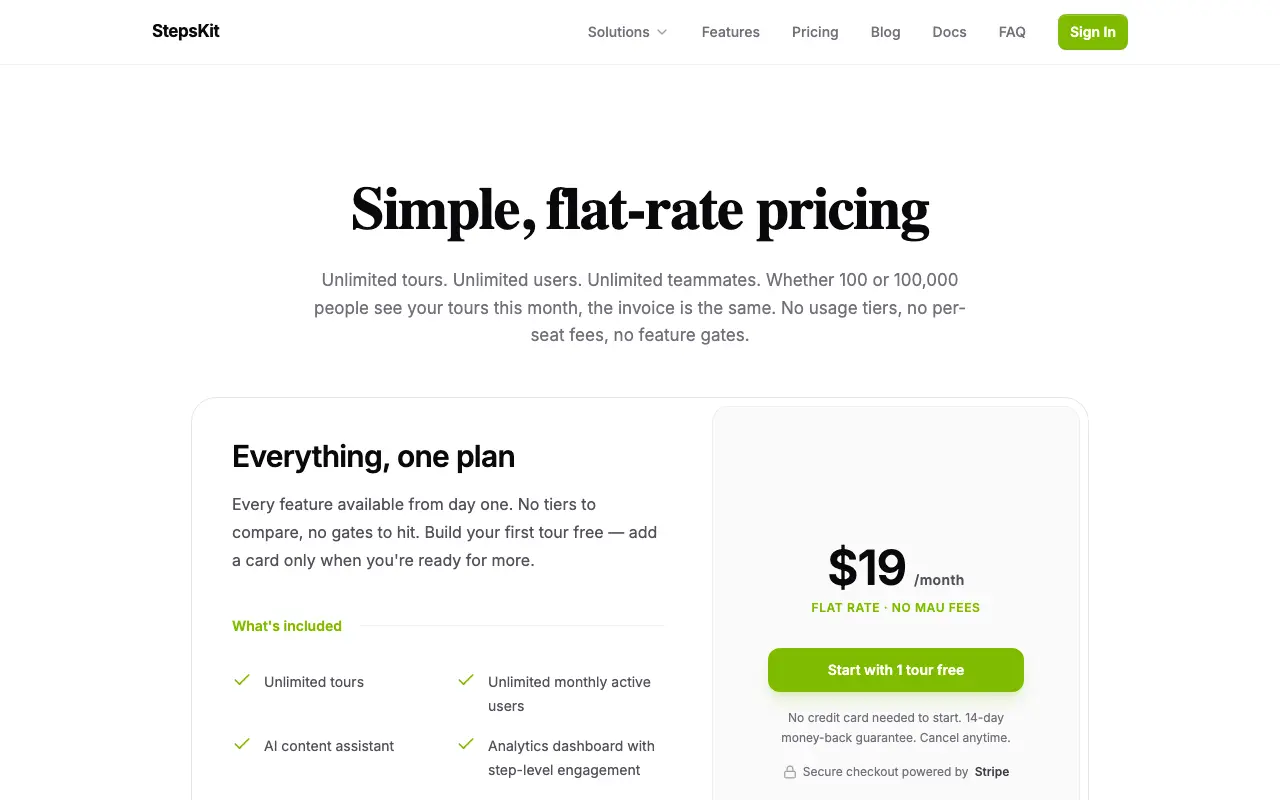
StepsKit is the publishing brand of this roundup (more on the publisher) and is one of the tools below. It exists because every adjacent option in May 2026 either starts at $400/mo, scales pricing with MAUs (so growing the product means a bigger bill), or requires a 30-minute sales demo before showing pricing. StepsKit is one flat plan: unlimited tours, unlimited users, no MAU caps. The first tour is free with no card, no demo, no calendar link.
Best for: founders shipping onboarding for the first time, or replacing a tool that is bleeding budget on per-MAU billing.
Limits: mobile SDKs, deep enterprise SSO, and a full Pendo-style analytics stack on day one are not the product's current focus.
Current pricing: see the pricing page.
UserGuiding
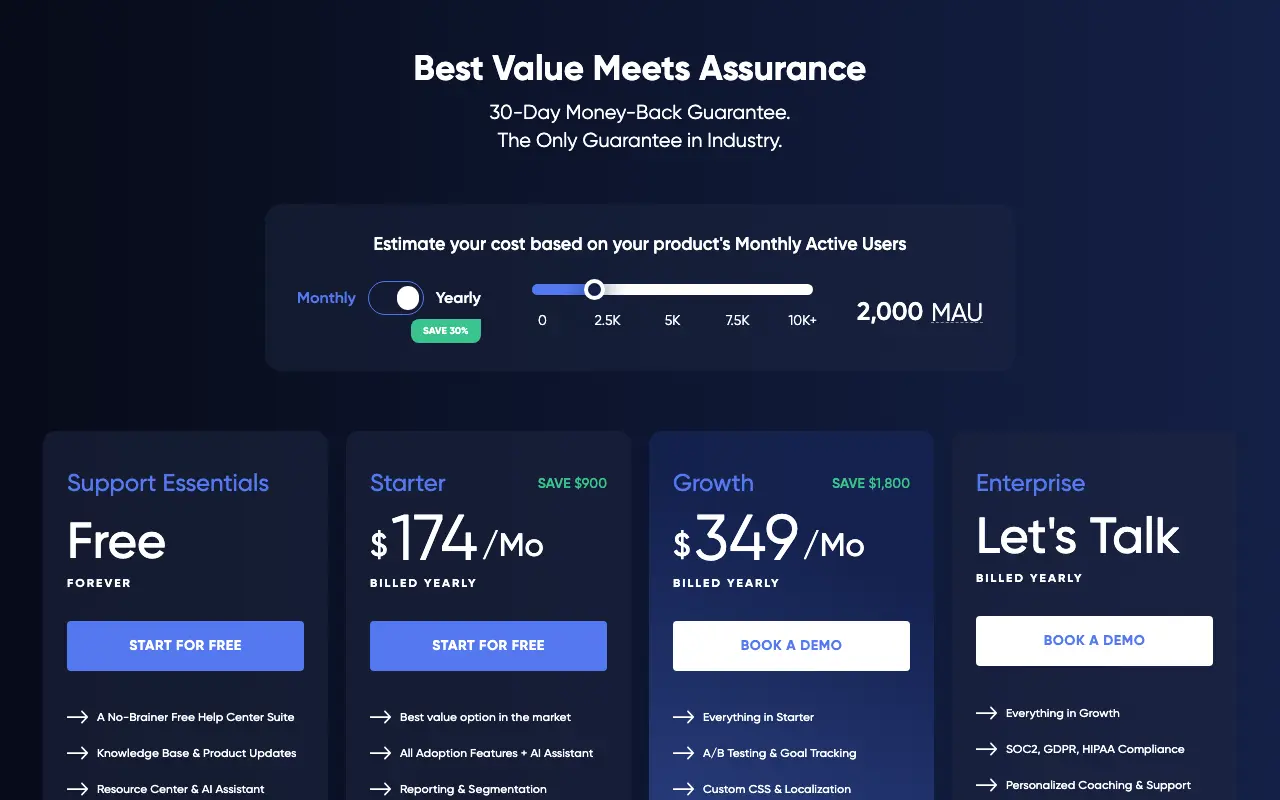
The clearest "budget mid-market" play in the category. UserGuiding publishes its pricing in full: Starter at $174/month billed yearly, Growth at $349/month billed yearly (vendor pricing page) — meaningfully cheaper than the mid-market tier above while covering the same core feature set: tours, checklists, in-app messages, basic segmentation. Enterprise is sales-only.
Best for: teams that need a "real" product adoption tool but cannot yet justify Appcues pricing.
Limits: the UI feels a generation behind newer tools; analytics are basic; upper pricing tiers reduce the price advantage. The StepsKit vs UserGuiding comparison sets out the per-plan content caps.
Supademo
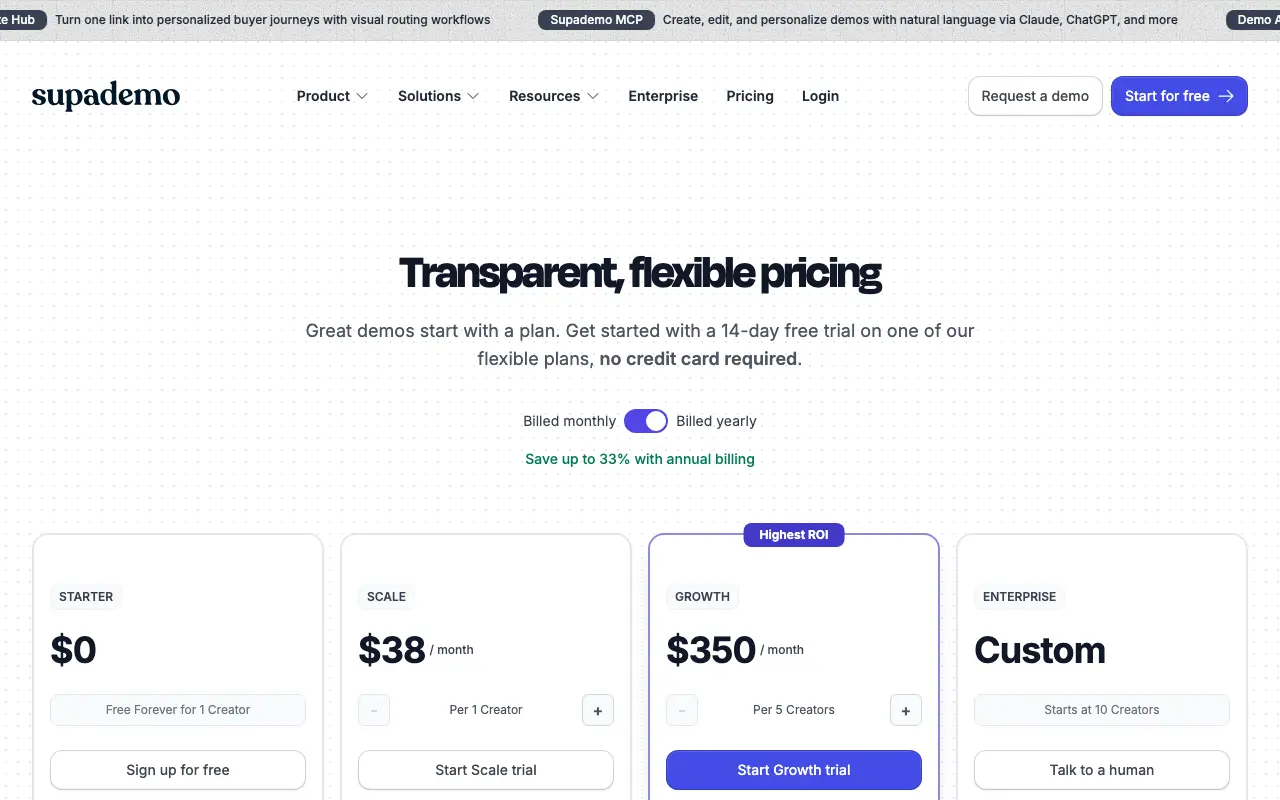
Supademo is closer to a "shareable interactive demo" tool than an in-app product tour, but ranks high on this SERP for a reason: the free tier is the most generous in the category, and AI-driven tour creation (record clicks, get a polished demo) is genuinely fast. If 70% of the relevant use case is sharing demos on a website or in sales emails rather than guiding users in-app, this may be sufficient on its own.
Best for: product-led teams whose main onboarding surface is pre-signup (the landing page) rather than post-signup (the app).
Limits: in-app capabilities are thinner than the dedicated tour tools below; "free forever" tiers in this category tend to add limits over time.
For growing SaaS (Series A → early Series B)
Product-led growth, a PMM (or someone wearing that hat), 1,000 to 50,000 MAU, and budget approval up to roughly $1,500/month for an onboarding tool. The three tools below are the de facto mid-market category. Pick on fit, not "ranking."
Appcues
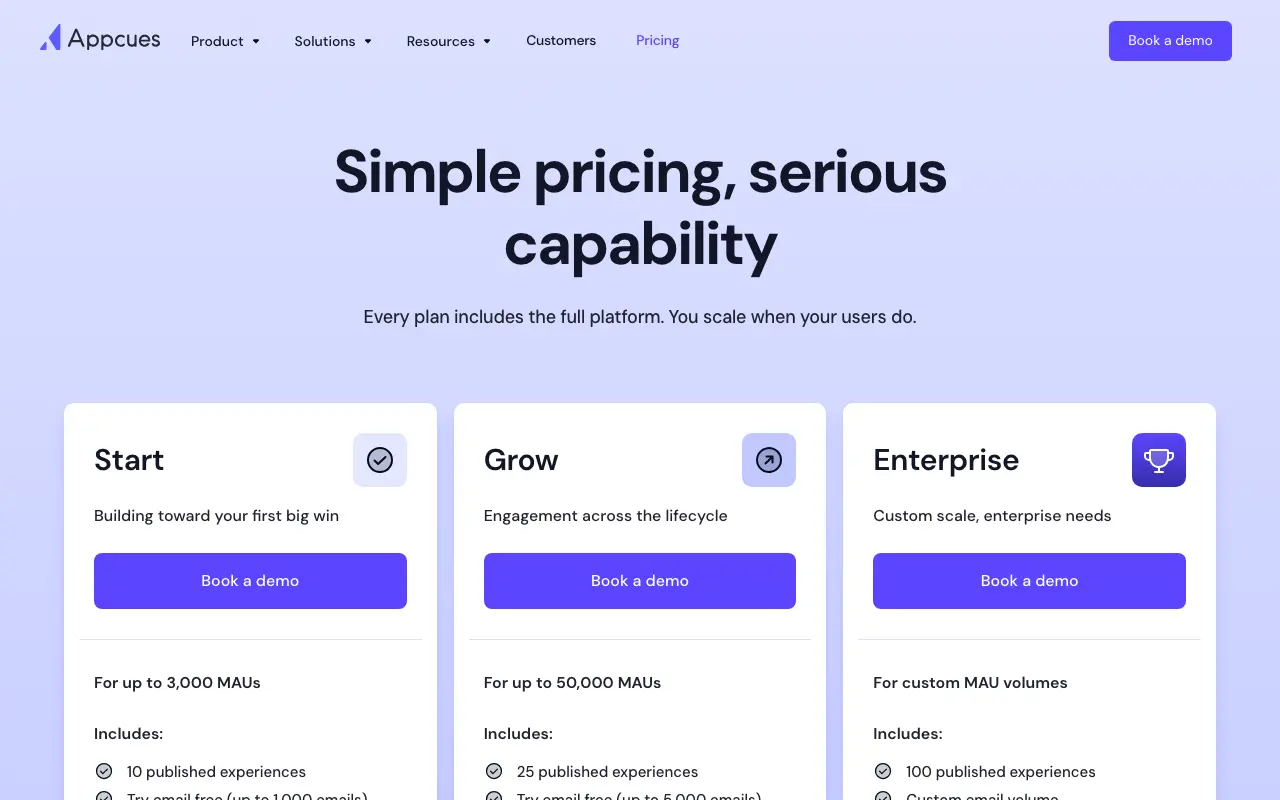
The classic. Founded 2013, the original mid-market product adoption tool. Solid no-code editor, mature segmentation, the best-known brand in the category. The pricing catch: as of May 2026, Appcues no longer publishes any dollar amounts — all three tiers (Start, Grow, Enterprise) say "Book a demo." Third-party roundups quote ~$249/month entry and ~$750/month for the Grow tier, but those numbers are not on the vendor's current page and the move to hide pricing is recent.
Best for: teams that want the safest, most-documented choice in the category and have budget approval for whatever the sales call lands on.
Limits: price-per-feature ratio has gotten harder to defend as cheaper tools caught up. Technical teams will outgrow the no-code-only constraints. The opaque pricing makes apples-to-apples comparison impossible without a sales call.
Chameleon
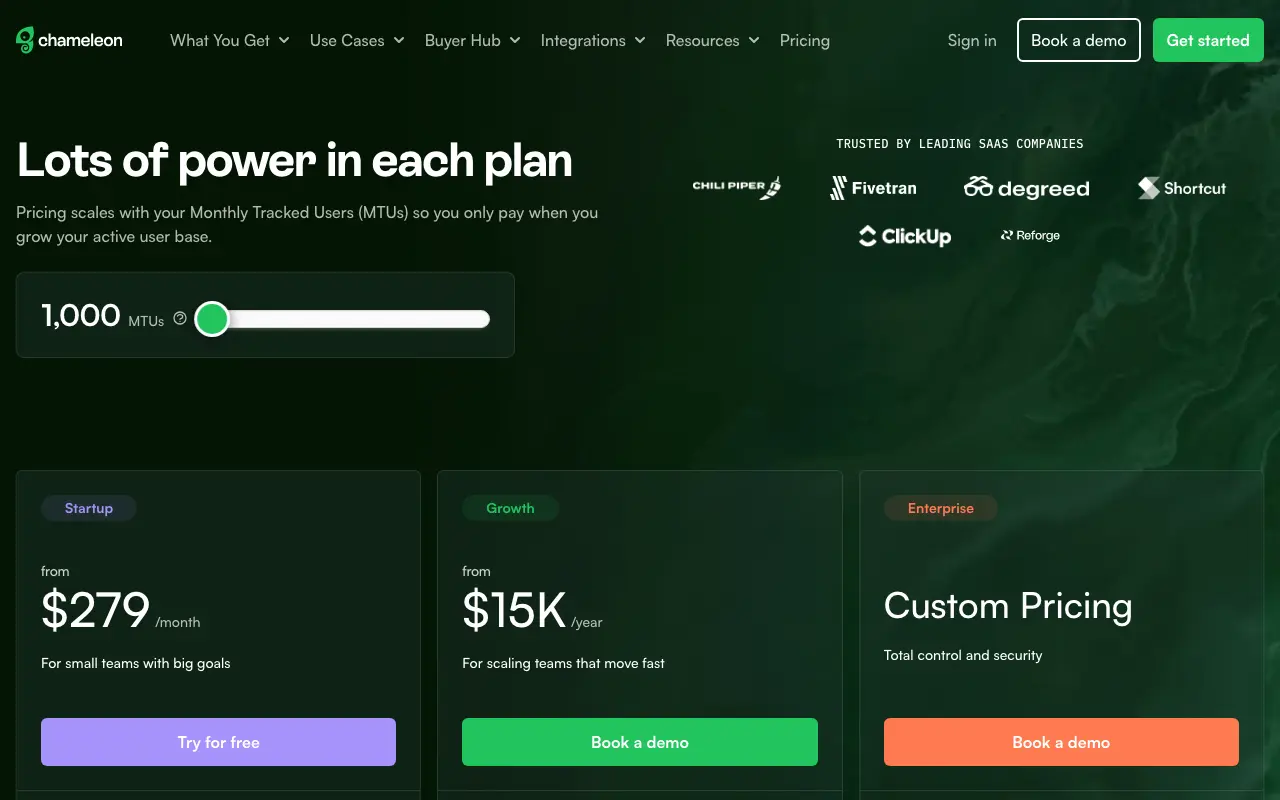
The design-flexible mid-market option. Chameleon's editor gives more granular control over UI than Appcues — closer to "tweaking CSS without touching CSS." The current pricing page publishes Startup from $279/month, Growth from $15K/year (~$1,250/month), and Custom Pricing for Enterprise — tiers selected via an MTU slider that scales prices up from those starting numbers. Third-party roundups commonly cite $1,500/month for Growth; the vendor's own page shows it slightly lower in annual terms.
Best for: brand-conscious SaaS where the default tour UI looks off-the-shelf and the design team has opinions.
Limits: the Startup → Growth jump ($279/month → ~$1,250/month equivalent) is steep; teams often get squeezed onto Growth before they actually need its features. For the flat-priced head-to-head, see the full StepsKit vs Chameleon comparison.
Userpilot
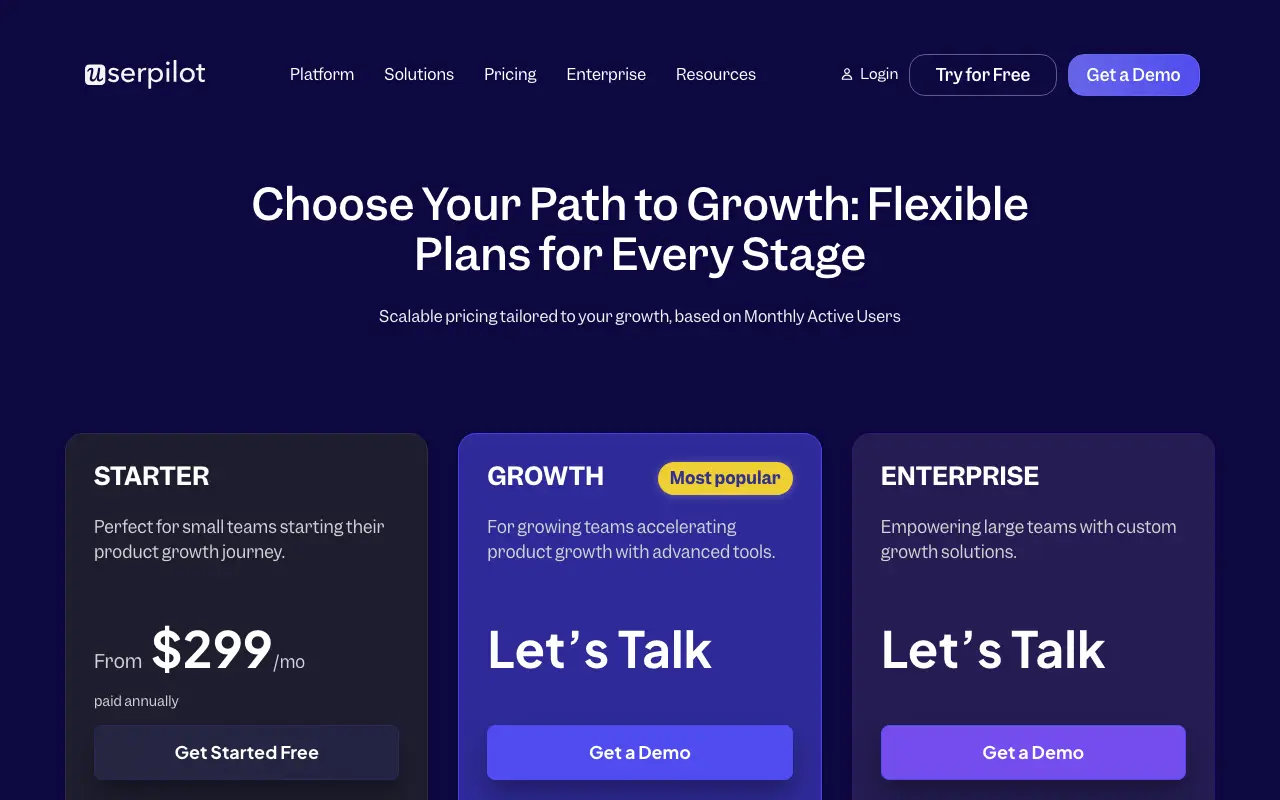
Built around the idea that no team should need three tools (tours + checklists + analytics) — Userpilot positions as all three. The Starter tier is published at $299/month billed annually; Growth and Enterprise tiers are sales-only. The bundled analytics is genuinely useful when replacing a separate analytics line item, less useful when the team is already on Amplitude or Mixpanel.
Best for: teams replacing a stack of two or three smaller tools with one mid-priced one.
Limits: as a generalist platform, no single piece is best-in-class. Mobile is paid extra.
For enterprise & multi-product orgs
If the buying process involves a procurement team, "Master Service Agreement" appears regularly in inboxes, and there is more than one product surface to onboard users through, this is the relevant tier. Pricing is custom, contracts are annual, and deal selection often comes down to procurement relationships as much as product fit.
Pendo
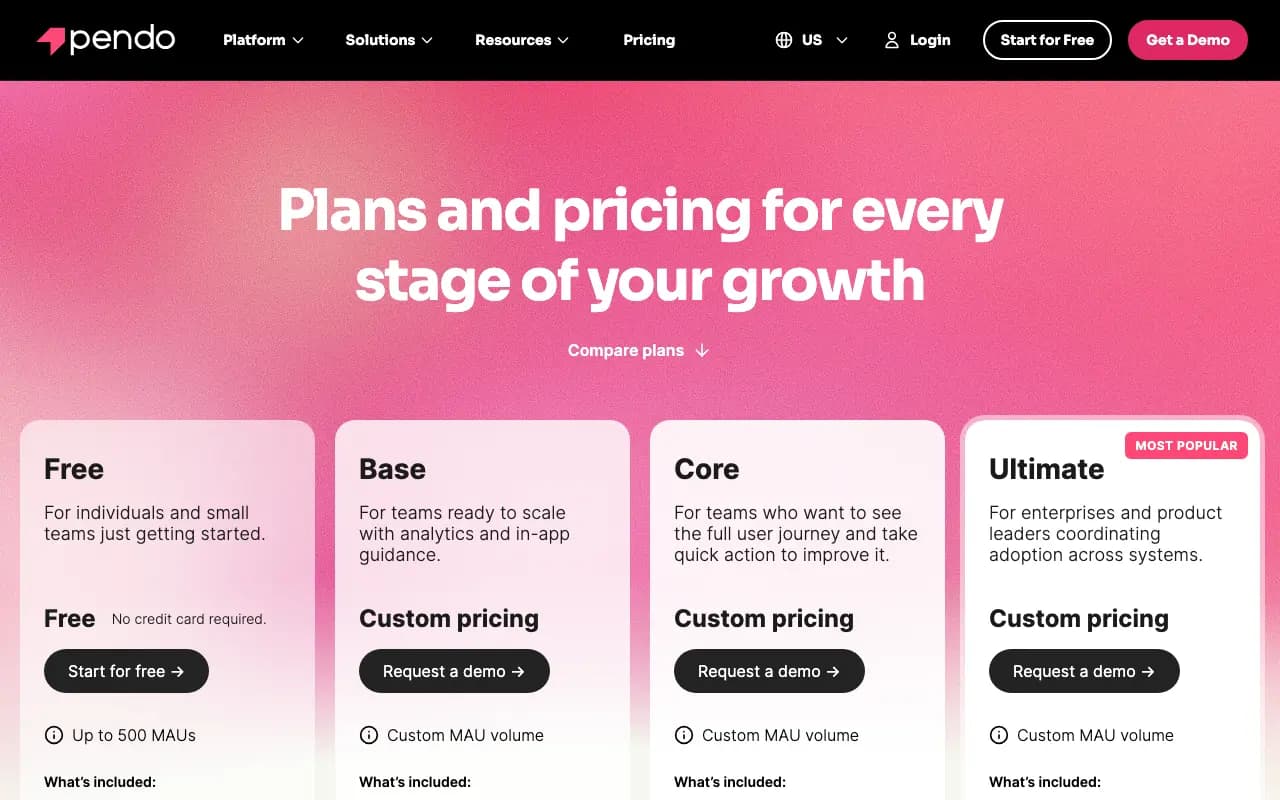
The enterprise default for SaaS companies. Tours, analytics, in-app messaging, NPS, and a roadmap planner under one roof. The pricing page publishes a Free tier (up to 500 MAUs) and three paid tiers — Base, Core, and Ultimate — all marked "Custom pricing" with "Request a quote" buttons. Third-party estimates place real Base deals around $7,000/year and mid-market Core/Ultimate deals in the $25K–$75K/year range, but those numbers are not on the vendor's page.
Best for: Series B+ SaaS with multiple internal teams (Product, CS, Marketing) all wanting analytics + onboarding from the same source of truth.
Limits: overkill if the need is only tours; integration timelines are measured in weeks, not days.
WalkMe
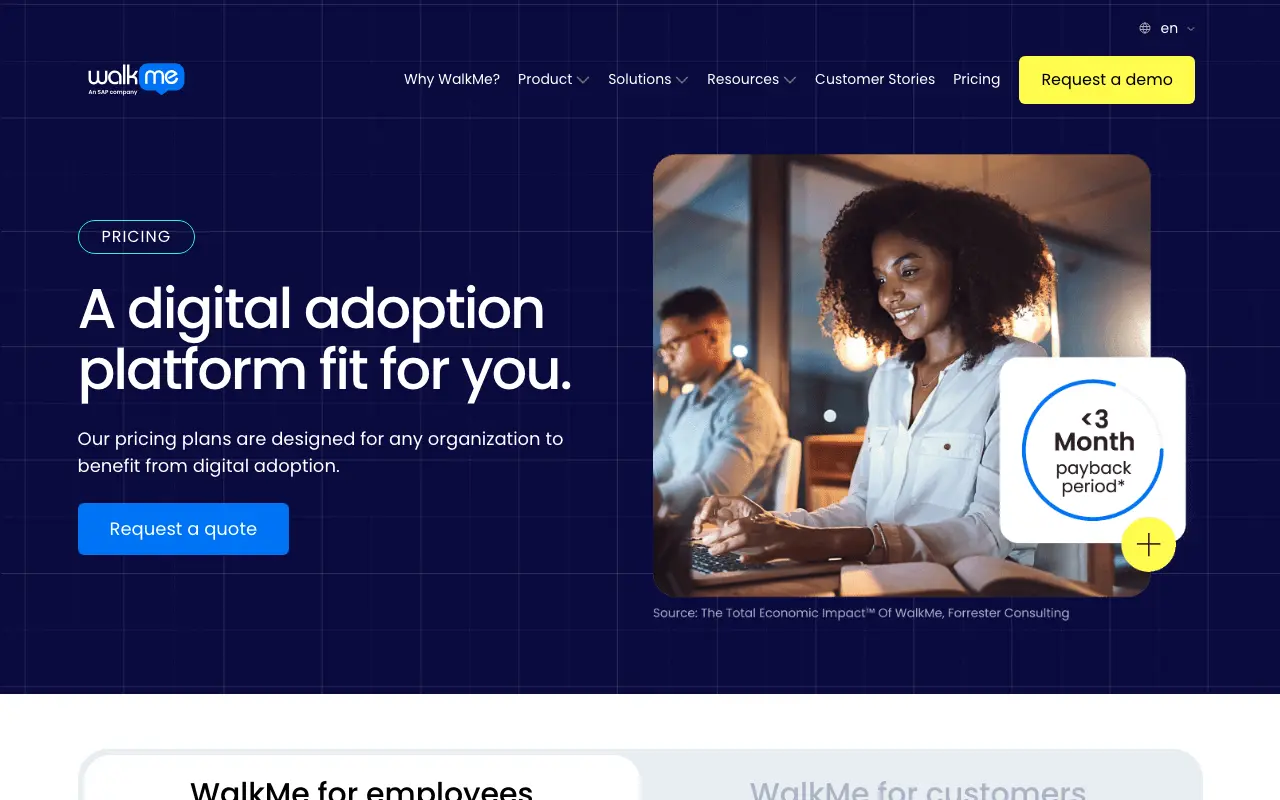
The grandparent of the category, founded 2011. Originally built for in-house enterprise app adoption (Salesforce, Workday, SAP), not SaaS product onboarding — though both use cases share UI primitives. Pricing is the most opaque in the category. The pricing page shows only a "Request a quote" button — no tiers, no numbers. Third-party estimates (per Userpilot's 2025 roundup) put the median annual cost around $43,828/year, with the lowest reported deals in the $20K range — both figures are second-hand, not vendor-confirmed.
Best for: large enterprises rolling out internal-tool training at scale.
Limits: sales cycle is enterprise-long; rarely the right tool for SaaS product onboarding unless the team is already a WalkMe shop.
Whatfix
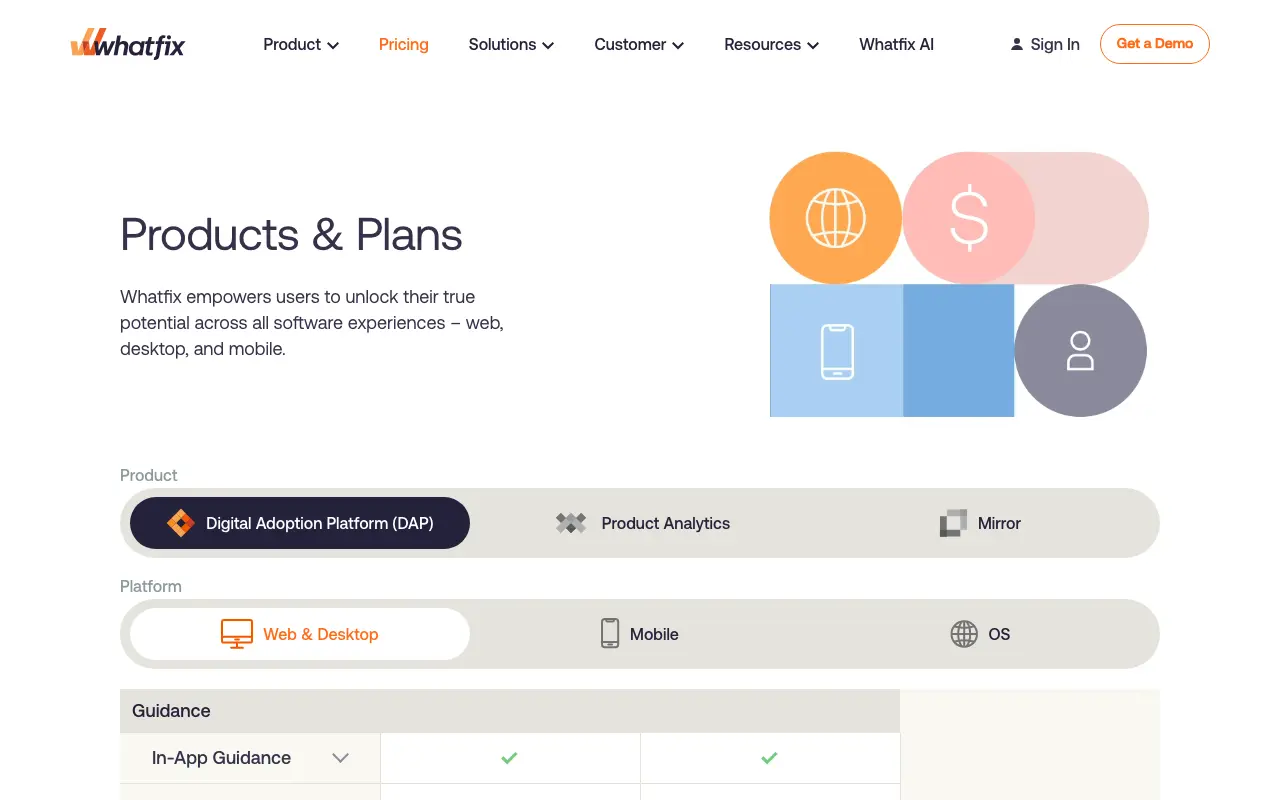
The other enterprise option, more focused on Digital Adoption Platforms (DAP) for multi-product orgs. Similar shape to WalkMe — custom contracts, enterprise sales cycle. Third-party data suggests deals start around $25K/year and scale into six figures for global rollouts. The pricing page shows a product/platform selection matrix (DAP / Product Analytics / Mirror, across Web/Mobile/OS) but no dollar amounts; everything routes to "Get a Demo."
Best for: large orgs with multiple internal SaaS tools (Salesforce + ServiceNow + Workday + a homegrown app) needing one adoption layer across all of them.
Limits: for a single SaaS product, this is the wrong category.
For sales-led teams selling on demo
Navattic
Navattic is not really competing with the tools above — it sits in an adjacent category called "interactive demos." Instead of guiding users inside an app post-signup, Navattic records a click-through of the product for embedding on landing pages, in sales emails, or on the homepage. The viewer never logs in; they see a sandboxed version of the UI.
A sales motion that involves a demo before signup makes this the right tool. A product-led motion (signup first, demo never) makes it the wrong category.
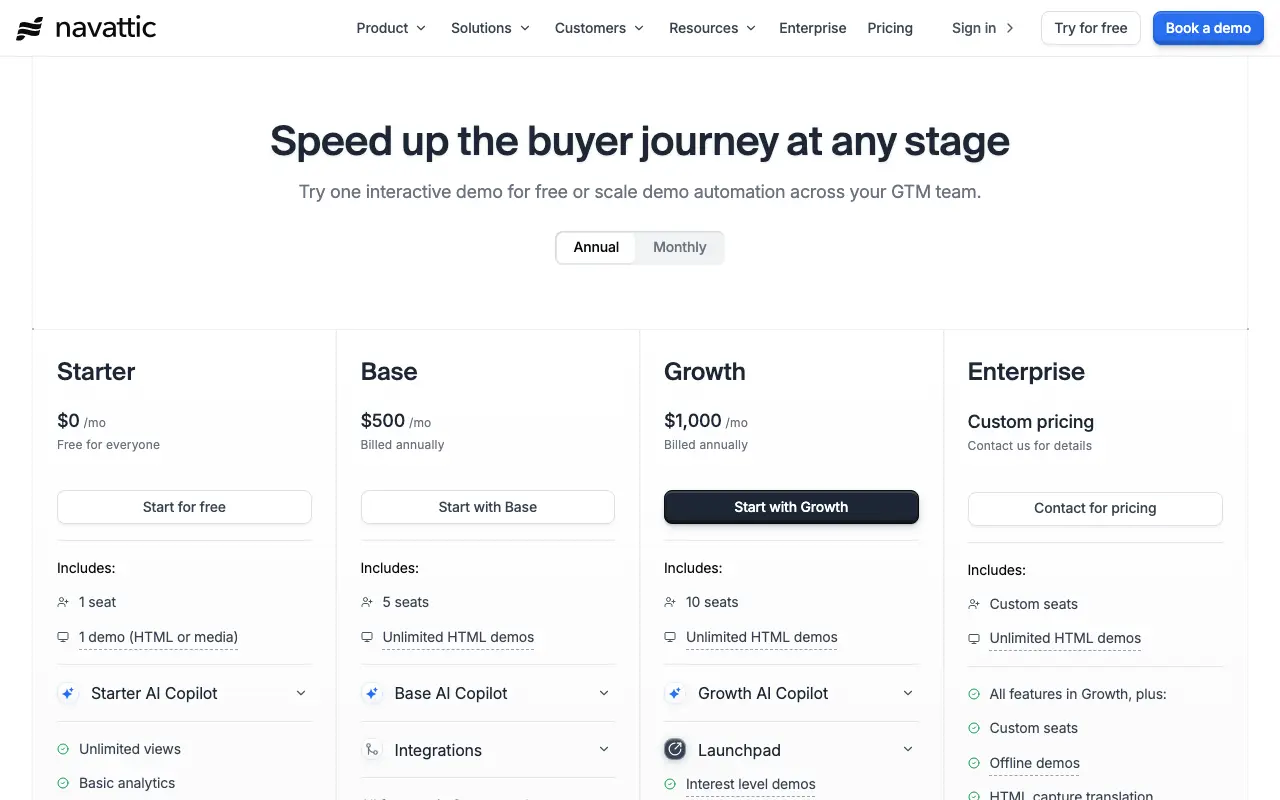
Pricing: The vendor's pricing page publishes Starter Free, Base $500/month (billed annually), Growth $1,000/month (billed annually), Enterprise Custom. Among the more transparent pricing pages in the category.
Best for: sales-led B2B SaaS, especially mid-market and enterprise. Case studies (MoEngage, Qualio, Spot AI) confirm the ICP.
For developer-heavy teams
Userflow
Userflow gets singled out because its API and component-level control are noticeably better than the no-code-first tools. When engineering owns onboarding (rather than CS or PMM), Userflow allows tours to be treated like real product features — versioned, tested, deployed alongside the app.
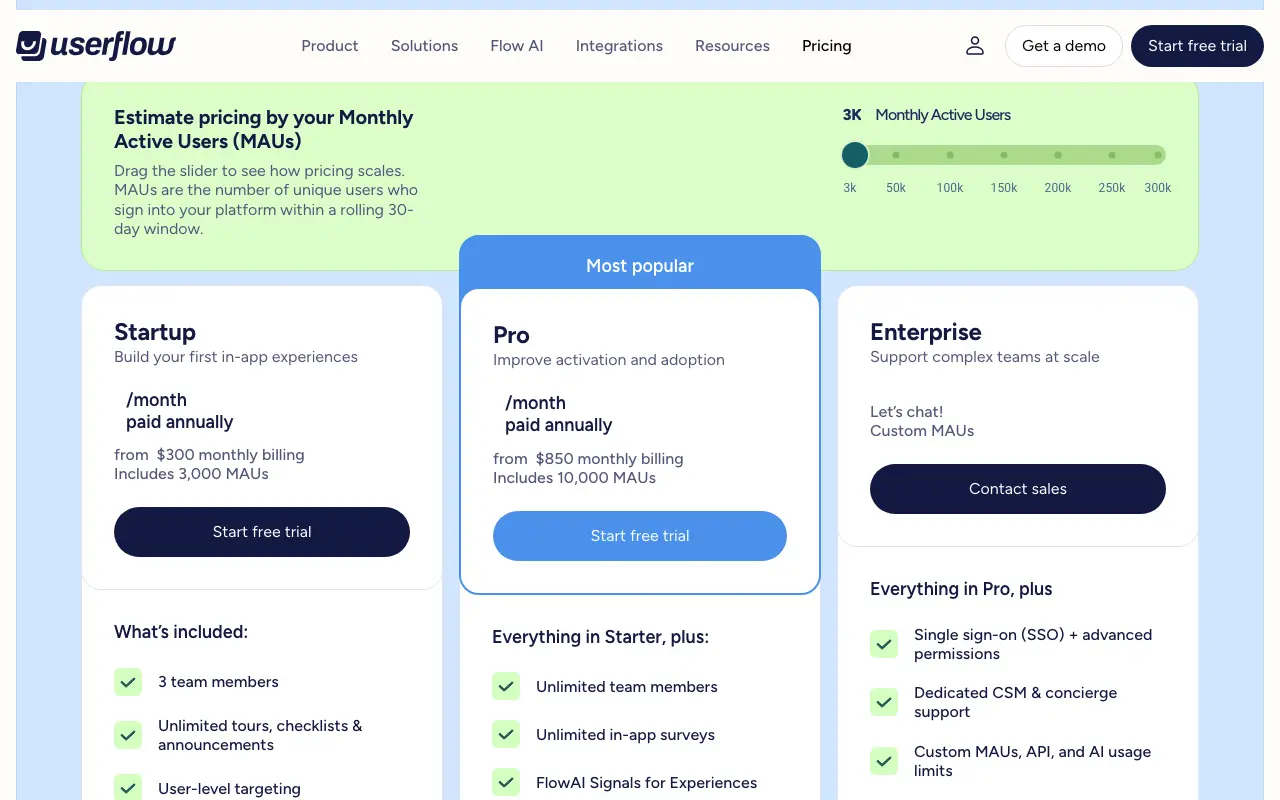
Pricing: The pricing page publishes an MAU-scaled model — Startup from $300/month (paid annually, 3,000 MAUs), Pro from $850/month (paid annually, 10,000 MAUs), Enterprise Custom. A slider lets buyers project the bill up to 300K MAUs.
Best for: engineering-led teams that prefer configuring things in code rather than in a visual editor.
Limits: the no-code editor is less polished than Chameleon's or Appcues' — this is intentional; Userflow assumes a developer in the room.
StepsKit also fits this category for the same reason. Teams that want flat pricing alongside developer ergonomics can see the pricing page for current numbers.
The pricing reality
Pricing transparency varies widely across this category. A fact-check against each vendor's pricing page on May 18, 2026:
| Tool | Entry tier (published May 18, 2026) | Higher tier (published) | Notes |
|---|---|---|---|
| StepsKit | Flat — see pricing | (same) | No MAU caps; first tour is free |
| UserGuiding | $174/mo Starter (billed yearly) | $349/mo Growth (billed yearly) | Enterprise sales-only |
| Userpilot | $299/mo Starter (billed annually) | Growth & Enterprise sales-only | Bundled analytics |
| Supademo | Free; $38/mo Scale (per creator) | $350/mo Growth (per 5 creators) | Enterprise custom |
| Chameleon | From $279/mo Startup | From $15K/yr (~$1,250/mo) Growth | Enterprise Custom; MTU-scaled slider |
| Navattic | Free Starter; $500/mo Base (billed annually) | $1,000/mo Growth (billed annually) | Enterprise Custom |
| Userflow | From $300/mo Startup (paid annually, 3K MAUs) | From $850/mo Pro (10K MAUs) | Enterprise Custom; MAU-scaled slider |
| Pendo | Free (up to 500 MAUs) | Base / Core / Ultimate all "Custom" | Three paid tiers gated behind sales. Third-party estimates: ~$7K–$75K/yr |
| Appcues | Not published | Not published | All three tiers "Book a demo." Third-party estimates: ~$249/mo entry, ~$750/mo Grow |
| WalkMe | Not published | Not published | "Request a quote" only. Third-party median ~$43,828/yr (Userpilot 2025) |
| Whatfix | Not published | Not published | Pricing page shows a product/platform matrix; no dollar amounts |
Three vendors fully hide pricing. Appcues, WalkMe, and Whatfix publish no dollar amounts on their pricing pages — every tier is "Book a demo" or "Request a quote." When a vendor moves pricing behind a sales call, the safe assumption is that publishing it would lose deals to cheaper competitors. Most competing roundups quote specific dollar amounts for these three vendors anyway, passing along older third-party estimates as if they were current vendor numbers. The figures above marked "Third-party estimates" are flagged for that reason.
One vendor (Pendo) splits the difference — Free tier is published, three paid tiers are sales-only. The other seven tools publish at least one tier's price, ranging from full transparency (Navattic, UserGuiding, Supademo) to "starts from X" with the actual ceiling sales-gated (Chameleon, Userflow).
When product tour software is the wrong purchase
A section the other listicles will not write, because the tools above pay them affiliate fees.
Product tour software is the wrong purchase when:
- The product has fewer than 50 active users and one onboarding flow. A custom implementation with React + Tailwind takes an afternoon and saves $300/month while keeping full control. Several decent open-source libraries also exist; integrating one is faster than the demo of any tool above.
- The "onboarding" problem is actually an empty-state problem. Most "user gets stuck" moments are solved by better empty states, sample data, or a clearer first run — not by adding tooltips on top of a confusing UI. Tours are a band-aid for product clarity. Fix the underlying product first.
- Users are technical and prefer self-service. Forcing a tour on a developer who would rather read the docs is a fast way to earn a 1-star review. Build docs, build a CLI quickstart, then maybe a tour — not the other way around.
- A tour is being used to compensate for missing features. "Click here to find the export button" → the export button should be findable. Tours that exist because the UI is confusing usually point to a UI problem, not an onboarding problem.
The honest framing: most products under 500 users do not need any of the tools in this post. The post is for products that have grown past that and now have a real onboarding problem to solve at scale.
The decision tree the analysis supports
For a team picking one tool from this list today, the decision flow:
- Solo founder, no PMM, under $5K/mo budget for the whole growth stack? → StepsKit for flat pricing, UserGuiding for the budget mid-market option, or a custom build.
- Series A, PMM in seat, $500–$1,500/mo budget? → Chameleon if design control matters, Appcues for the safe brand, Userpilot for bundled analytics.
- Series B+, custom contract acceptable, multi-product? → Pendo by default. WalkMe only when already a WalkMe customer for internal tools. Whatfix for a true multi-product DAP need.
- Selling on demo before signup? → Navattic. Different category from the above.
- Engineering-led onboarding, code control required? → Userflow or StepsKit, depending on pricing-model preference.
The wrong decision in this category is rarely picking the "second-best" tool. It is paying mid-market pricing (estimated $700–$1,500/month range) when a published $174/month tool would have done the job, or signing a five-figure enterprise contract eighteen months before the team actually needs enterprise features.
Common questions
Is product tour software the same as a digital adoption platform (DAP)? No. Product tour tools (Appcues, Chameleon, UserGuiding, StepsKit) are built for SaaS companies onboarding their own users. DAPs (WalkMe, Whatfix) are built for enterprises rolling out third-party software internally — different buyer, different scale, different price point. There is overlap in the underlying tech (tooltips, walkthroughs) but the categories are distinct. For a full breakdown of that category, see our digital adoption platform comparison.
Is a free open-source library sufficient? For one or two tours in a small app, often yes. Several libraries handle the core mechanics. The reason teams move off them is usually some combination of: needing non-engineers to author tours, wanting segmentation and targeting without writing code, needing analytics on tour completion, and not wanting to maintain the library themselves.
What is the ROI on this category of tool? Honest answer: hard to measure cleanly. The argument in favor — better activation → better retention → more revenue — is real, but attributing the lift to the tour itself (versus broader onboarding improvements) is messy. The case for spending money here is strongest when there is a specific, measurable activation problem (e.g., "only 30% of signups reach the second key action"), not when the goal is a vague "improve onboarding."
Are AI-generated tours actually useful? Some of these tools (notably Supademo and ProductFruits) now offer "AI shows the product, AI builds the tour." Output is faster than building manually, but the result usually still needs a human pass. Treat it as a draft, not a finished tour.
How long does this category lock buyers in for? Mid-market tools usually require annual commitments for any meaningful discount. Enterprise tools (Pendo, WalkMe, Whatfix) are always annual, and migrating off a year's worth of tours, segmentation rules, and analytics setup is a real cost. Choose with that in mind.