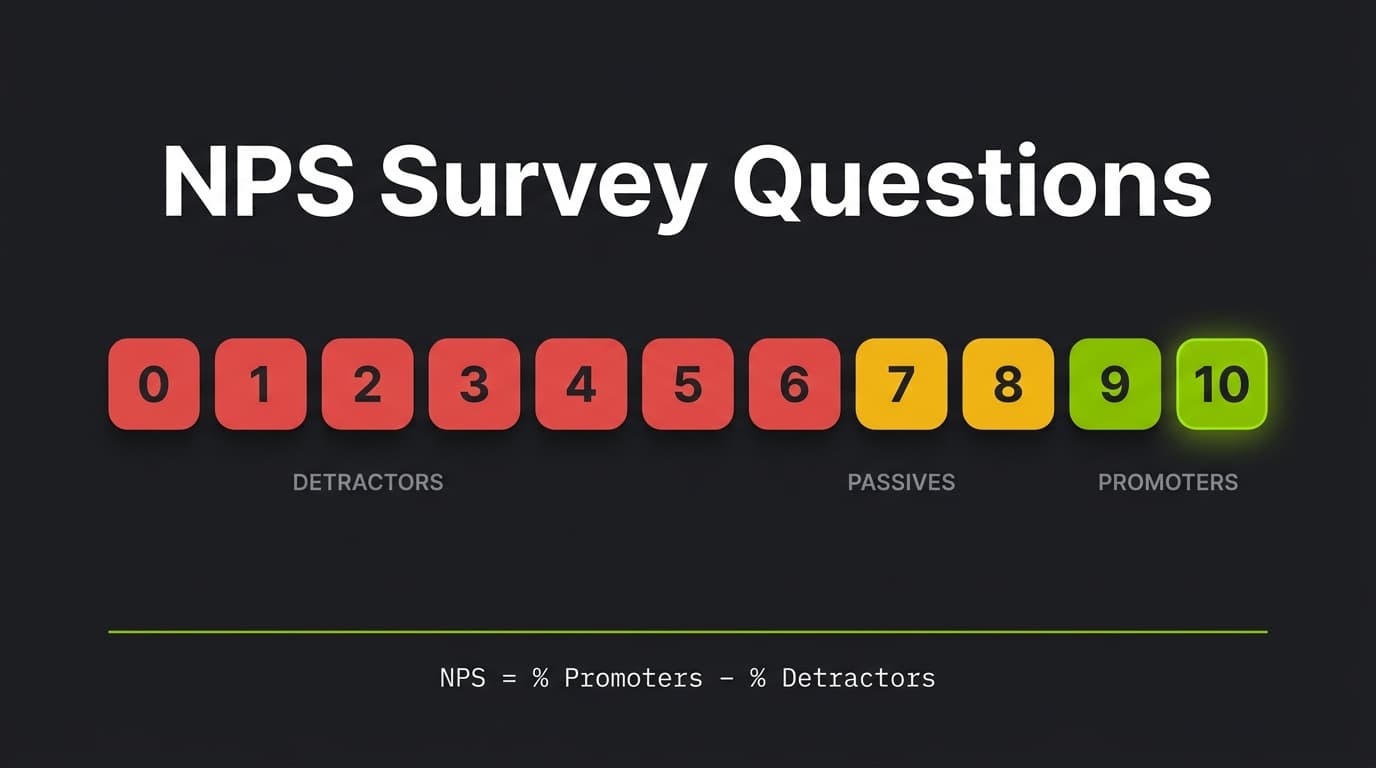
Net Promoter Score rests on a single question. Get the wording right, add one good follow-up, and ask it at the right moment, and you have a loyalty metric you can actually act on. Get it wrong and you have a number nobody trusts. This is the standard NPS question, the follow-ups worth asking, how the score is calculated, and what counts as good.
The standard NPS survey question
The canonical NPS question is:
How likely are you to recommend [product] to a friend or colleague?
Respondents answer on a 0–10 scale, where 0 is "not at all likely" and 10 is "extremely likely." That phrasing — and the 0–10 scale — is what makes a score comparable to everyone else's NPS. Change the question or the scale and you've built a different metric that you can no longer benchmark against industry numbers.
A few defensible variations on the wording:
- "How likely are you to recommend us to a friend or colleague?"
- "How likely are you to recommend [product] to a coworker?" (better for B2B, where "friend" is the wrong audience)
- "Based on your experience so far, how likely are you to recommend [product]?"
Keep the 0–10 scale and the word "recommend." Everything else is yours to tune.
What is NPS (Net Promoter Score)?
NPS is a customer-loyalty metric introduced by Fred Reichheld in a 2003 Harvard Business Review article, "The One Number You Need to Grow," and developed with Bain & Company. The premise: the willingness to recommend a product is a strong proxy for loyalty, and loyalty predicts growth.
Instead of averaging the 0–10 answers, NPS buckets respondents into three groups and takes the difference between the best and worst. That makes it more sensitive to extremes than a plain average — one detractor cancels out one promoter, and the lukewarm middle barely moves the number.
The 0–10 scale: promoters, passives, and detractors
Every 0–10 response falls into one of three buckets:
| Group | Score | What it means |
|---|---|---|
| Promoters | 9–10 | Loyal enthusiasts who'll recommend you and fuel word-of-mouth. |
| Passives | 7–8 | Satisfied but unenthusiastic — easily lured by a competitor. |
| Detractors | 0–6 | Unhappy users who can damage your brand through negative word-of-mouth. |
The split is deliberately lopsided: a 7 or 8 is a passive, not a promoter. NPS sets a high bar on purpose — only genuine enthusiasm counts in your favor.
How to calculate your NPS score
The formula is:
NPS = % Promoters − % Detractors
Passives are counted in the total but don't add to either side. The result ranges from −100 (everyone's a detractor) to +100 (everyone's a promoter).
A worked example. Say you collect 100 responses:
- 50 promoters → 50%
- 30 passives → 30%
- 20 detractors → 20%
NPS = 50% − 20% = +30.
Note that passives quietly drag the score down: they take up share of the total without contributing to the promoter percentage. A product with lots of 7s and 8s can have a mediocre NPS even with very few detractors.
What is a good NPS score?
Any score above 0 means you have more promoters than detractors. Beyond that, "good" depends heavily on your industry, so the most useful comparison is against your own trend and your direct competitors — not a global average. A commonly cited interpretation from the NPS community:
| NPS range | Read |
|---|---|
| Below 0 | More detractors than promoters — a problem to fix. |
| 0 to 30 | Good — room to improve. |
| 30 to 70 | Great — strong loyalty. |
| 70+ | World-class. |
Treat these as rough guidance. A 30 might be excellent in a category with notoriously low scores and unremarkable in one with high ones. The signal that matters most is direction: is your NPS climbing or sliding, and which changes moved it?
The NPS follow-up question (and why it matters more than the number)
The score tells you what. The follow-up tells you why — and the why is where the roadmap lives. Always pair the rating with one open-text question:
- Neutral, all-purpose: "What's the main reason for your score?"
- For detractors (0–6): "What's the one thing we could do to improve?"
- For promoters (9–10): "What do you love most about [product]?"
The detractor comments are the most valuable thing in the entire survey. A user who scores you a 3 and tells you why is handing you a save opportunity and a bug report at once. A pattern across those comments is your prioritized backlog.
Tailoring the follow-up to the bucket — asking promoters what they love and detractors what to fix — yields sharper answers than one generic prompt. Keep it optional, though; forcing a comment depresses your response rate.
NPS survey question examples by goal
The recommend question stays the same, but the surrounding questions can shift with what you're trying to learn:
- Relationship NPS (overall loyalty): the standard question, sent on a regular cadence (e.g. quarterly) to all active users.
- Transactional NPS (a specific moment): "How likely are you to recommend [product] based on your onboarding experience?" asked right after a key event.
- Feature-specific feedback: pair a lighter 1–5 or emoji rating with "How would you rate the new [feature]?" rather than the full NPS question — a microsurvey scoped to one screen.
Match the instrument to the question. NPS is for loyalty; a 1–5 or emoji scale is better for "did this one thing work?"
Where to ask: email vs. in-app
The same question performs very differently depending on the channel.
Emailed NPS reaches people who've left your product, days after the experience it's about. Response rates skew low and biased — mostly your superfans and your angriest users reply, and the quiet majority never opens the email.
In-app NPS asks the question where the user already is, while the experience is fresh. Response rates are higher and the sample is more representative, because you're reaching active users in context rather than whoever happens to check their inbox.
For SaaS, in-app is almost always the better surface. It's also the moment you can target precisely — show the survey only to users on a certain plan, who've reached a certain milestone, or who are on a specific page.
NPS survey mistakes to avoid
- Changing the question or scale. The moment you do, your number stops being comparable to anyone else's NPS, including your own past scores.
- Asking too often. Surveying the same user every session trains them to dismiss it. Set a re-survey window — every 90 days is a common cadence — and respect it.
- Asking too early. A user who signed up an hour ago can't tell you whether they'd recommend you. Wait until they've reached real value.
- Skipping the follow-up. The bare number is a vanity metric. The comments are the part you act on.
- Measuring without closing the loop. Collecting scores and never following up with detractors wastes the most useful signal you have.
How to run an NPS survey in your app
If you want NPS where your users actually are, StepsKit's in-app surveys run the recommend question on a 0–10 scale (plus 1–5 and emoji scales for lighter microsurveys), add an optional open-text follow-up, and compute promoters, passives, detractors, and your NPS automatically. You target who sees it the same way you'd target a product tour — by plan, role, or page — and set a re-survey window so nobody's asked too often.
It installs with the same single script tag as the rest of StepsKit, so if you're already running onboarding tours or tooltips, surveys are already available. Ask one good question, in the right place, and let the score take care of itself.