Pendo bundles two products: enterprise-grade product analytics and in-app guides. Most teams that go shopping for an alternative aren't unhappy with both — they're paying a custom annual contract for the whole bundle while leaning on one half of it. One CX lead put the pattern plainly when explaining a switch: "we were paying lots, and we were not using it." So the useful question isn't "what's most like Pendo" — it's which half of Pendo you actually use. This guide compares eight real alternatives across both halves — guides-first tools and analytics-first platforms — with an honest read on which team each fits, and a note on which vendors publish their pricing, because beyond Pendo's free tier, every paid plan is a quote.
Why teams look for a Pendo alternative
Pendo earns its place at the enterprise end: retroactive analytics that answer questions without pre-instrumenting events, session replay tied to funnels and NPS, native mobile SDKs, and a breadth reviewers genuinely praise — "you'd need 3–4 other services otherwise." The reasons teams start shopping anyway, drawn from recurring G2, Capterra, and procurement-data themes:
- The contract is the #1 cited reason to leave. Every paid tier is a custom quote, typically deep into five figures a year, and terms are now annual-only. Former customers describe cost as hard to justify — especially when only part of the platform gets used.
- Renewal is about to get bigger, not smaller. Pendo is sunsetting its Feedback module in favor of Listen, a separately priced add-on that becomes the mandatory path after 2026 — a fresh line item to negotiate at renewal.
- It needs a dedicated owner. Feature and page tagging "grows tedious at scale," non-technical stakeholders struggle with segments and reports, and reviewers describe needing a trained admin to keep it all trustworthy.
- Guides are the weaker half. Custom guide styling frequently requires CSS and engineering help, and reviewers call the multi-step walkthrough experience rough on both the admin and the end user.
- The bundle cuts both ways. A recurring review line: the product's focus is so wide that both the analytics side and the adoption side suffer for it.
If your organization genuinely uses both halves — Product, CS, and Marketing working from the same behavioral data, with guides riding on top — staying and negotiating is a legitimate outcome of this comparison.
What to look for in a Pendo alternative
Five questions that separate these tools more than any feature grid does:
- Which half do you actually use? Pull your last quarter of usage. If it's mostly guides, an onboarding tool replaces Pendo at a fraction of the cost. If it's mostly analytics, an analytics platform does — and both camps below have started growing into the other half.
- Who builds and maintains it? A non-technical PM, a product analyst, or an engineer. The guides-first tools optimize for the first; PostHog and Amplitude assume the second or third.
- How does it charge — and does it tell you? Flat, per-MAU, usage-based, or custom contract. After a sales-gated Pendo contract, pricing you can read on a page is itself a feature.
- Which surfaces? Pendo covers web and native mobile. Most guides-first alternatives here are web-first; the analytics platforms cover mobile analytics but their new guide layers are web-first too.
- Setup and ownership weight. Pendo's real cost includes the dedicated admin. Decide whether the replacement should remove that role or just re-house it.
The 8 alternatives at a glance
| Tool | Best fit | Who builds tours | Setup effort | Built-in analytics | Pricing model |
|---|---|---|---|---|---|
| StepsKit | Replacing the guides half, flat cost | No-code (non-technical) | Low | Step-level, built in | Flat |
| Product Fruits | All-in-one breadth on a budget | No-code | Low | Basic | Tiered + per-MAU |
| UserGuiding | Gentlest editor, real free tier | No-code | Low–moderate | Basic | Tiered + per-MAU (free tier) |
| Userflow | Developer-friendly onboarding | No-code + code-first | Moderate | Moderate | Per-MAU, published |
| Appcues | Polished no-code + native mobile | No-code | Moderate | Moderate | Sales-gated (MAU) |
| Userpilot | Closest like-for-like, mid-market | No-code | Moderate | Deep (bundled) | Per-MAU, entry published |
| PostHog | Replacing the analytics half, dev-led | Engineers (low-code) | Moderate (dev) | Deepest, usage-based | Usage-based, free tier |
| Amplitude | Enterprise analytics, guides emerging | Analysts + no-code guides | Heavy | Deepest, enterprise | Free tier + gated upper tiers |
1. StepsKit — best for replacing Pendo's guides half at a flat price
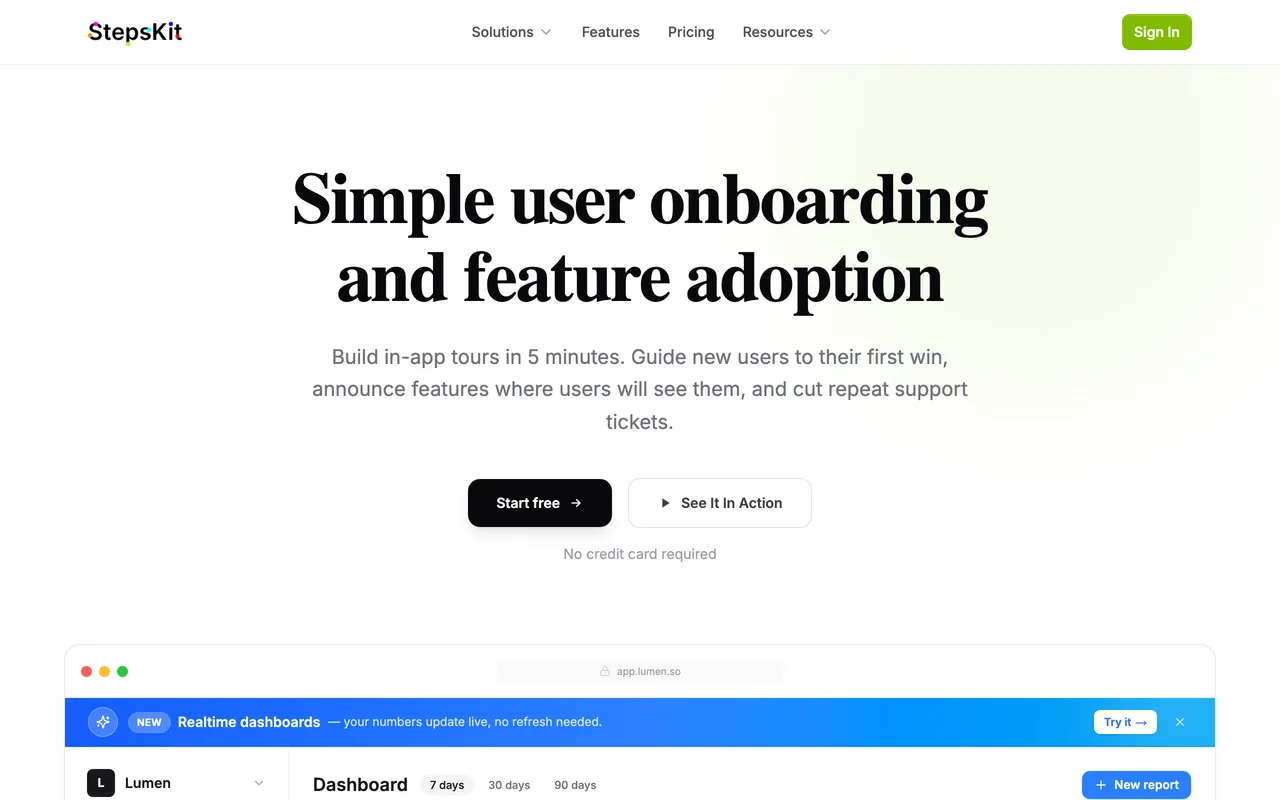
If your Pendo usage report says "guides, mostly," this is the sharpest version of the trade: StepsKit does in-app tours, targeting, and step-level analytics — and deliberately nothing else. There's no analytics suite to configure, no tagging taxonomy to maintain, and no dedicated admin role to staff. Write a tour, theme it to your brand, target it, ship it the same afternoon.
The pricing is the other half of the argument: a flat monthly plan, published on the site, with no MAU meter — a tour seen by 100,000 users costs the same as one seen by 100. For a team walking away from a five-figure contract it was half-using, that math is usually the whole decision. In-app surveys are included for the NPS-style feedback loop, and an AI assistant drafts step copy from a blank tour.
What it does well:
- Live in minutes — no implementation project, no dedicated admin, no CSS required for styling
- Flat monthly pricing, published — no MAU meter, no quote, no annual lock-in
- Step-level tour analytics built in, so drop-off is visible per step
- In-app surveys included for lightweight NPS and feedback
- Audience targeting, page-level visibility rules, and brand theming without engineering
- First tour is free — no credit card, no demo call
Where it falls short: no product-analytics suite or session replay — it pairs with the analytics you already have rather than replacing Pendo's data half; web-first, with no native iOS/Android SDKs; and no enterprise governance/SSO depth today.
Best for: teams replacing onboarding tours and feature adoption without re-buying an analytics platform they already own — see the full StepsKit vs Pendo comparison for the head-to-head.
The tradeoff: you keep only the half you were using and the invoice shrinks accordingly — a sidegrade if retroactive analytics or native mobile is why you bought Pendo.
2. Product Fruits — best for all-in-one breadth on a budget
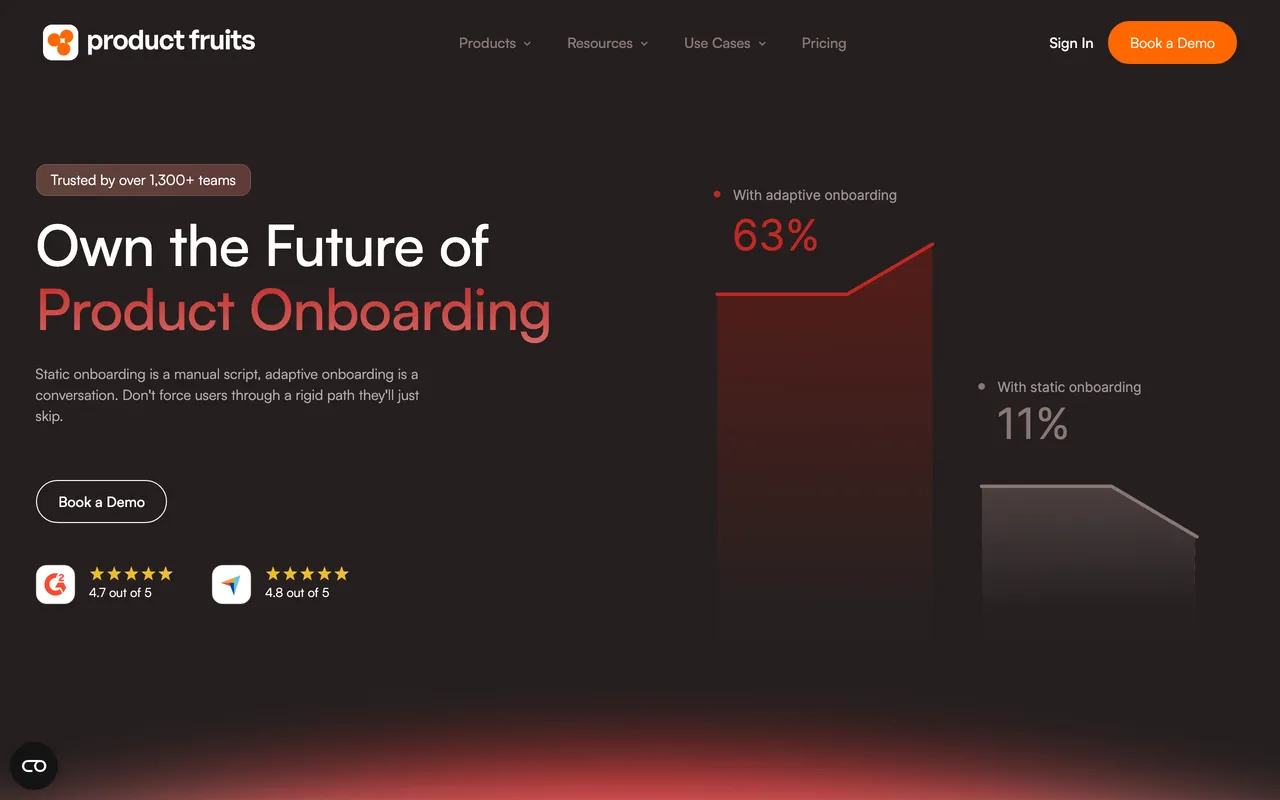
Product Fruits is the budget re-creation of Pendo's adoption side: tours, checklists, announcements, feedback collection, a knowledge base, and an AI support bot, at published prices whose entry tier sits below everything else on this list. Signup is self-serve and the full-access trial doesn't ask for a card — the opposite of a quote-based sales cycle.
The 2026 push is Elvin, its AI copilot: AI-generated onboarding flows and an in-app agent that answers "how do I…?" questions by triggering the relevant tour, included across tiers rather than gated upmarket. The trade is polish and depth — design flexibility is limited and analytics stay shallow.
What it does well:
- The lowest published entry price on this list, self-serve from day one
- Broad bundle — tours, checklists, announcements, feedback, knowledge base — without stitching tools
- No-code editor with a minimal learning curve
- AI onboarding and support bot included across tiers
- Fast, well-reviewed human support
Where it falls short: limited visual and layout control, so pixel-perfect brand matching is out of reach; analytics report views and completions but little behavioral insight; and CRM/CDP integrations are thin.
Best for: SMBs that want most of Pendo's adoption checklist at a small fraction of the spend.
The tradeoff: the most features per dollar here, paid for in polish and analytical depth — it still meters on MAUs, just from a low base.
3. UserGuiding — best for the gentlest editor, with a real free tier
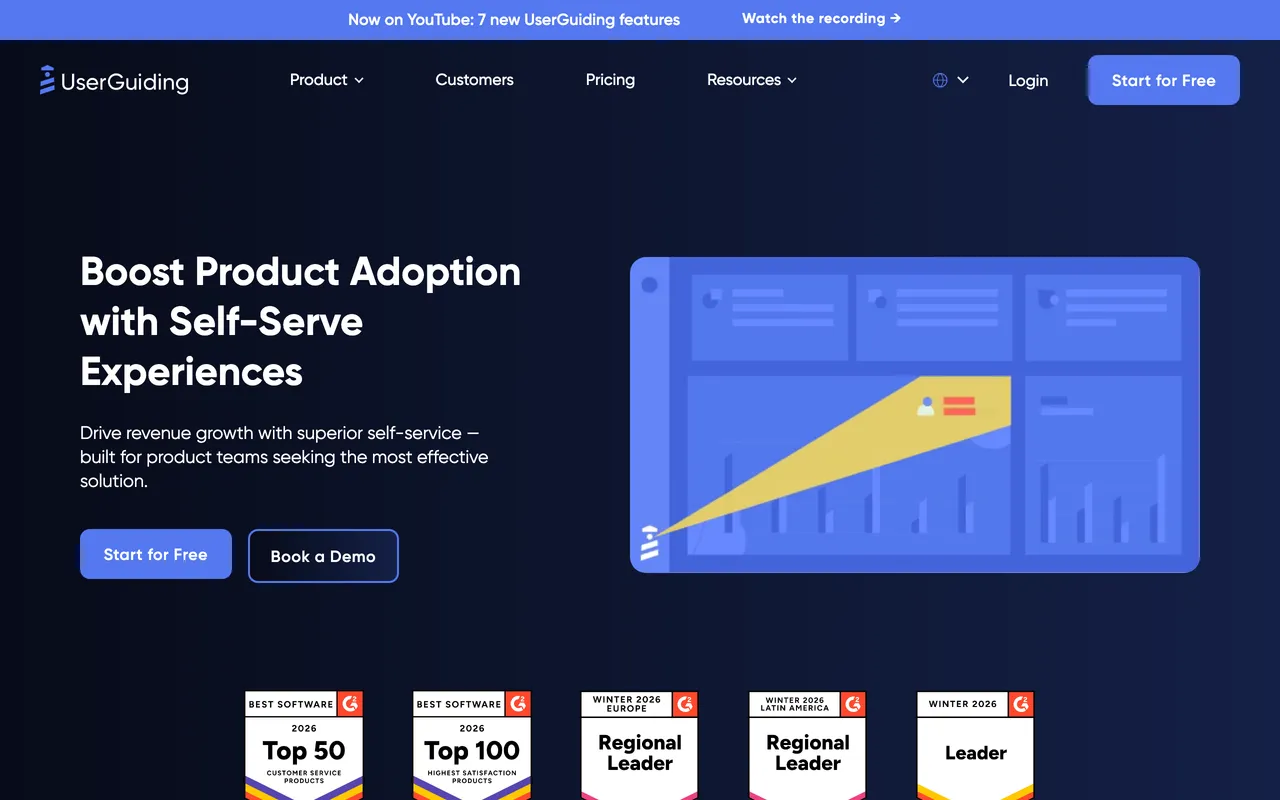
UserGuiding attacks Pendo's dedicated-admin problem directly: an editor non-technical teammates genuinely pick up, plus checklists, surveys, a resource center, and a knowledge base out of the box. Its free-forever tier (knowledge base, product updates, AI assistant) is the lowest-risk way on this list to test whether a lighter tool covers your guides workload.
The honest caveat is pricing trajectory rather than product: the most-repeated recent review complaint is renewal bills rising sharply — several G2 reviewers report subscriptions roughly doubling within a year — plus usage caps that feel tight on lower tiers. Negotiate terms at signature, not at renewal.
What it does well:
- Consistently rated the easiest editor in the category to learn — no admin role required
- Genuine free-forever tier, plus published prices for paid tiers
- Broad module bundle: guides, checklists, surveys, resource center, knowledge base
- AI assistant included even on the free tier
- Strong satisfaction scores on G2 and Capterra
Where it falls short: review threads flag steep renewal increases and stingy usage caps; customization is uneven across modules; and analytics plus advanced segmentation stay basic — no substitute for Pendo's data half.
Best for: teams whose Pendo friction was complexity and cost, and whose analytics needs live elsewhere.
The tradeoff: the friendliest on-ramp here, with a pricing trajectory worth pinning down contractually up front. StepsKit vs UserGuiding breaks that trajectory down by user band.
4. Userflow — best for developer-friendly onboarding
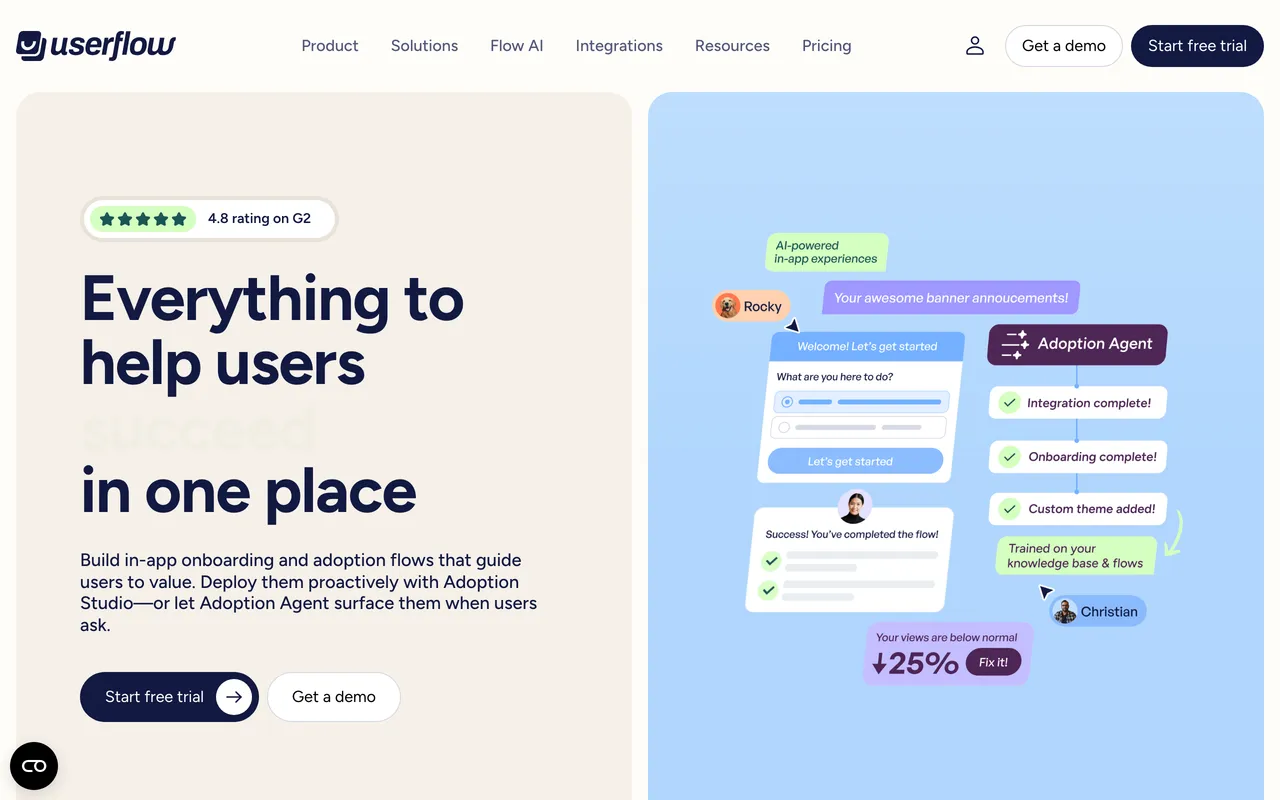
Userflow suits the team that concluded Pendo's guides half needs engineering anyway — so engineering may as well own a tool built for it. Its standout is a CSS-selector engine that keeps tours attached to complex, dynamic single-page apps without littering the codebase with element IDs, and its builder is fast enough that teams report publishing ten-plus flows in the first week.
Acquired by Beamer in early 2024 and still developed as a standalone product, its current push is FlowAI: record a walkthrough of your app and it drafts the flow, plus auto-translation and an in-product Adoption Agent that answers user questions with guidance. Pricing is published — only the enterprise tier requires a conversation.
What it does well:
- Exceptionally smooth builder with fast time-to-value
- Selector engine that survives complex and dynamic UIs — the most-cited standout in reviews
- FlowAI: AI-recorded flows, auto-translation, in-app adoption agent
- Published pricing with transparent per-MAU overage
- Checklists, surveys, banners, and a resource center included
Where it falls short: analytics are the thin spot — reporting trails Userpilot, let alone Pendo; there's no template library, so flows start from scratch; and several must-haves (unlimited surveys, localization, advanced integrations) sit on the pricier second tier.
Best for: product teams with an engineer in the loop who want guides treated like a real product feature.
The tradeoff: precision and developer ergonomics over analytical depth — you'll keep a separate analytics tool.
5. Appcues — best for polished no-code guidance with native mobile
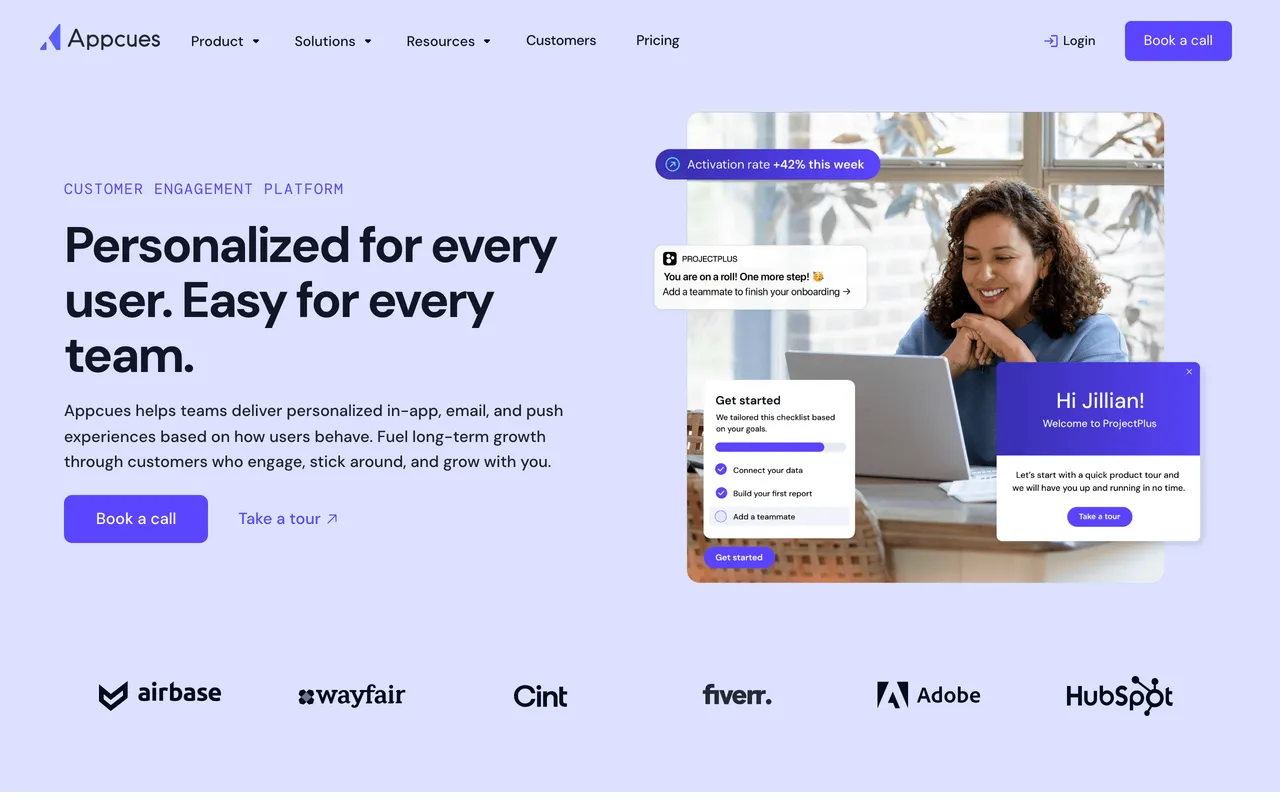
Appcues is the closest match for a team leaving Pendo's guides half that can't give up native mobile: its iOS/Android SDKs are mature, and its Workflows orchestrate in-app, email, and push from one canvas — lifecycle reach Pendo only offers via a separate Orchestrate SKU. The no-code builder is among the most polished in the category, with the documentation depth of a 2013-vintage incumbent.
The catch will feel familiar: Appcues publishes no prices either — every tier is a sales conversation, metered on MAUs — so it cures Pendo's guide problems without curing the procurement one. The bill is typically smaller, but you won't know by how much until the call. There's a full Appcues alternatives comparison if you want that SERP's version of this exercise.
What it does well:
- Mature native mobile SDKs — the rarest capability among guides-first alternatives
- Multi-channel Workflows: in-app, email, and push on one canvas
- One of the most polished no-code builders in the category
- Deep documentation and a strong support reputation
- Established vendor with a large enterprise customer base
Where it falls short: fully sales-gated MAU pricing means no upfront comparison; setup runs heavier than the marketing suggests, with reviewers citing engineering involvement; and its native analytics are basic — the same "pair it with a data tool" story as the lighter options.
Best for: teams replacing Pendo's guides across web and native mobile, with budget for a mid-market contract.
The tradeoff: the most complete guides-half replacement — at the cost of re-entering a quote-based buying process.
6. Userpilot — best for the closest like-for-like Pendo replacement
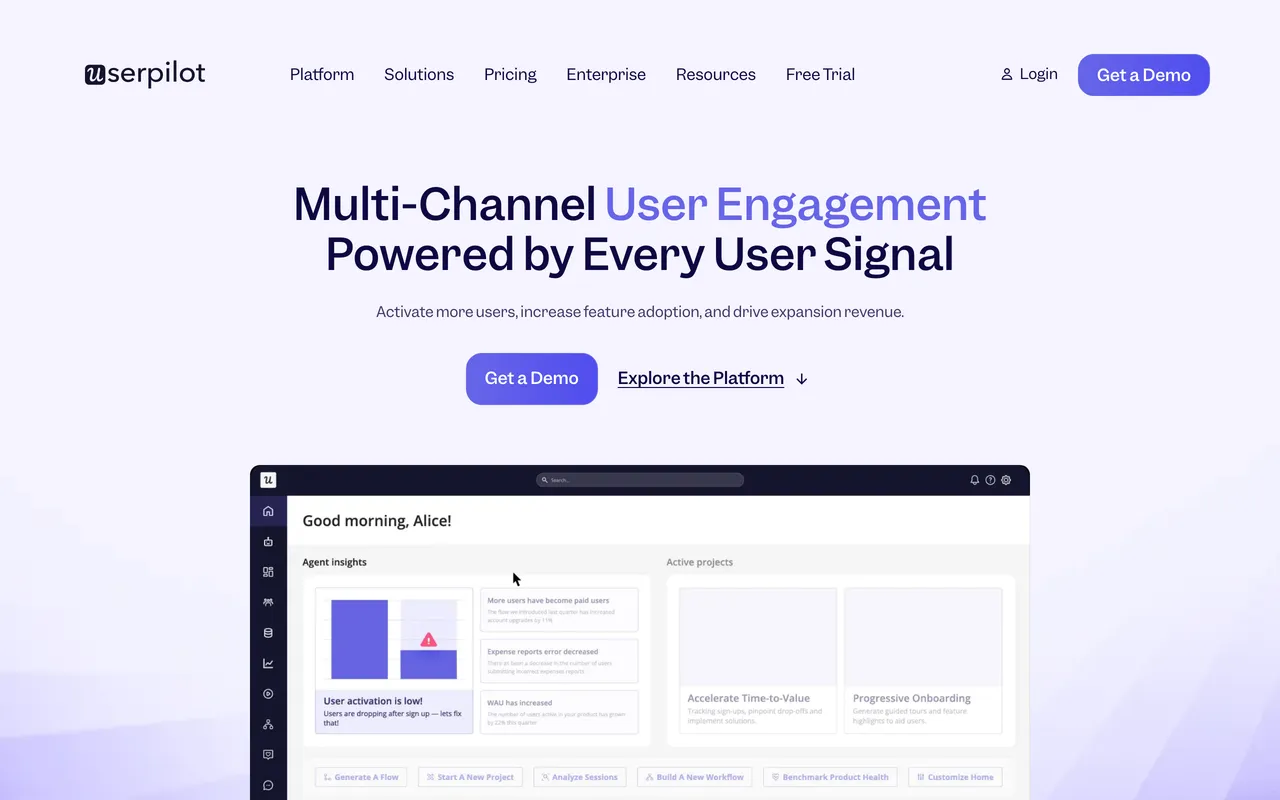
Userpilot is the shrink-to-fit Pendo: flows, checklists, surveys, NPS, and genuine product analytics — funnels, feature usage, cohorts — in one mid-market platform with a published entry price. For a team that really does use both Pendo halves but chokes on the contract, this is the most direct translation of the same shape into a smaller bill.
It inherits a proportional share of Pendo's weight, too: the dominant review complaint is the learning curve, and the published entry tier's MAU cap is low enough that growing teams get routed to sales-gated tiers quickly. Session replay and mobile are paid add-ons. For the mirror-image exercise, see the Userpilot alternatives roundup.
What it does well:
- The closest feature shape to Pendo below enterprise pricing: guides + real analytics in one
- Strong segmentation and event-based targeting
- Native NPS and microsurveys
- Published entry pricing and a free trial — no demo required to start
- Native mobile available as a paid add-on
Where it falls short: the learning curve is the most-cited complaint by a wide margin — expect a real ramp, if not a Pendo-sized one; deep visual customization is limited; and real costs live in the sales-gated tiers above the low-cap entry plan.
Best for: mid-market teams that genuinely use both Pendo halves and want the same bundle at a smaller scale.
The tradeoff: the most faithful replacement, inheriting a scaled-down version of the same complexity and metering.
7. PostHog — best for replacing Pendo's analytics half, developer-led
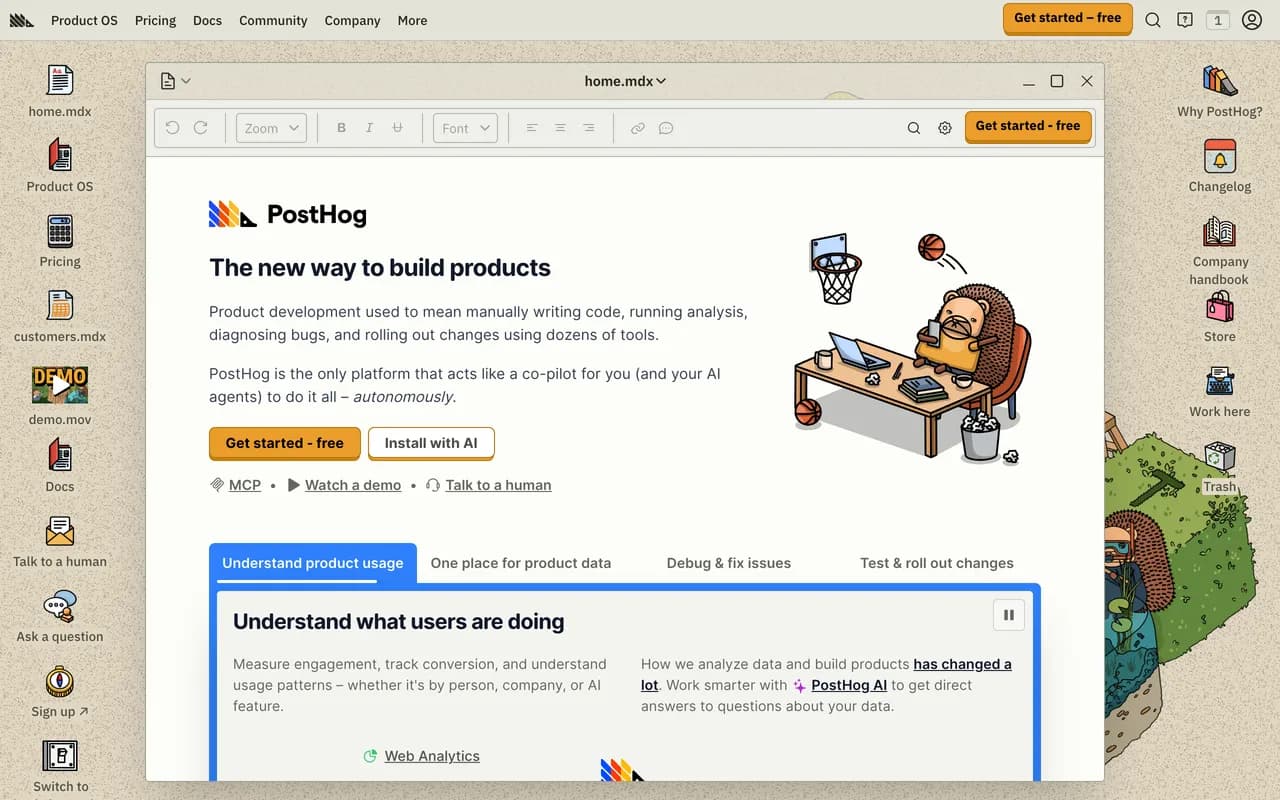
If your Pendo usage report says "analytics, mostly," PostHog is the developer-world answer: product analytics, session replay, feature flags, A/B experiments, surveys, error tracking, and a data warehouse on one usage-based bill, with free monthly allowances generous enough that small products run on it for free indefinitely. Pricing is published to the fraction of a cent per event — the philosophical opposite of a custom quote.
The 2026 twist: PostHog now ships Product Tours — element-highlighting steps, modals, banners, embedded survey questions — so the "it has no guidance layer" objection is out of date, though that layer is young and thin next to Pendo's. Know what you're buying: PostHog assumes engineers are driving, and non-technical teams tend to find its breadth overwhelming.
What it does well:
- Deep product analytics plus session replay, flags, experiments, and surveys on one bill
- Radically transparent usage-based pricing with genuinely useful free allowances
- Developer-loved: fast SDK setup, self-hosting option, excellent docs, huge community
- Replay tied directly to analytics for fast friction-spotting
- New Product Tours layer feeds tour events straight into funnels and cohorts
Where it falls short: the learning curve and product sprawl are the most-cited complaints — without an engineer or analyst driving, it overwhelms; multi-meter usage pricing is hard to forecast; and the guidance layer is nascent — no match yet for a mature onboarding tool.
Best for: engineering-led teams replacing Pendo's data half — with tours as a bonus, not the reason to switch.
The tradeoff: enormous capability per dollar in exchange for technical ownership — the anti-Pendo on pricing transparency, and also on hand-holding.
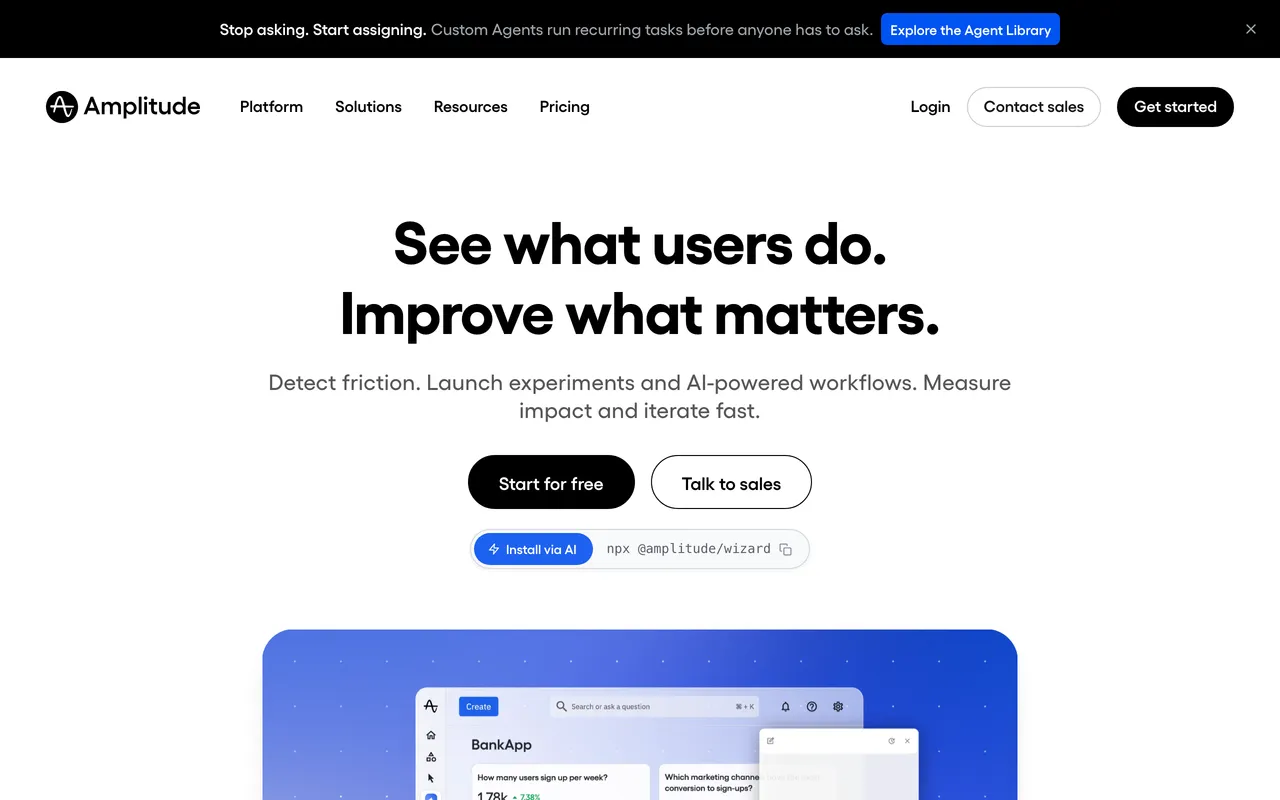
8. Amplitude — best for enterprise-grade analytics, with guides emerging
Amplitude is the enterprise path for the analytics-half camp: behavioral analytics deeper than Pendo's, and since early 2025, a native Guides and Surveys layer — tooltips, checklists, announcements — that makes it a direct rival rather than an adjacent tool. Every plan, including a genuinely usable free tier, now carries the full platform: analytics, session replay, experimentation, guides, and its 2026 fleet of AI agents.
Two honest caveats. The guides layer is a year old and evaluators still score it well behind Pendo on the guidance job specifically — buy Amplitude for the data, not the tours. And while entry pricing is public, the cost complaint pattern rhymes with Pendo's: at scale, event volume makes it one of the most expensive tools in its class, with upper tiers sales-gated.
What it does well:
- Best-in-class behavioral analytics: funnels, cohorts, retention, pathfinding at enterprise depth
- Full platform on every plan — analytics, replay, experimentation, guides, AI agents — including the free tier
- Native Guides and Surveys turn analytics segments directly into in-app guidance
- Trusted enterprise standard with strong governance tooling
- Real-time triggers and public entry pricing — more transparent than Pendo's quote-only ladder
Where it falls short: cost at scale is the #1 complaint — event-volume pricing climbs fast and upper tiers are sales-gated; non-technical users face a weeks-long learning curve; and the young guides layer trails Pendo's mature engagement suite.
Best for: data-led enterprises consolidating analytics, experimentation, and (increasingly) guidance on one platform.
The tradeoff: deeper analytics than the tool you're leaving, with a cost curve and complexity that will eventually feel familiar.
How to choose
Match the tool to which half of Pendo you actually use, not to a leaderboard:
- Guides, mostly — and the contract stings? → StepsKit (flat price, simplest) or UserGuiding (free tier to test with).
- Guides across web and native mobile? → Appcues, or Userpilot's mobile add-on.
- Engineering owns onboarding? → Userflow, or PostHog if they want the analytics too.
- Analytics, mostly? → PostHog (developer-led, usage-priced) or Amplitude (enterprise depth).
- Genuinely both halves, smaller bill? → Userpilot is the closest like-for-like.
- Budget is the whole story? → Product Fruits' entry tier or UserGuiding's free plan.
When you don't need a Pendo alternative at all
A section the affiliate-funded roundups skip. Switching is the wrong move when:
- You truly use both halves, org-wide. If Product, CS, and Marketing all work from the same Pendo data with guides on top, nothing on this list replaces that one-for-one — you'd be re-assembling it from two tools.
- Retroactive analytics is load-bearing. Pendo's tag-today-see-history model is genuinely rare. Every event-based alternative starts collecting from the day you instrument it.
- The pain is the renewal quote, not the product. Pendo contracts are negotiated, discounts on the Listen add-on exist, and procurement leverage is real. A renegotiation costs days; a migration costs a quarter.
- You're under the free tier's ceiling. Small products fit inside Pendo's free plan — if that's you, the contract problem solves itself.
- The real problem is the product, not the onboarding. Most "users get stuck" moments are first-run-clarity problems. Neither a cheaper tour tool nor deeper analytics fixes a confusing screen.
Bottom line
Strip away the brand names and the decision is an audit: open Pendo, look at what your team actually used last quarter, and buy that. If it's guides, the honest replacements are StepsKit, UserGuiding, Product Fruits, Userflow, or Appcues — in rising order of weight. If it's analytics, PostHog or Amplitude. If it's honestly both, Userpilot shrinks the bundle rather than splitting it.
And if the guides half is the half you kept — tours live fast, on predictable flat pricing, without a sales call or an MAU meter — that's the problem StepsKit was built for, and the first tour is free if you'd rather try it than take our word for it. Whatever you choose, buy the half you use: the wrong-fit bundle is expensive at any price.
Common questions
What is the best Pendo alternative? It depends on which half of Pendo you use. For guides only, StepsKit is the simplest and Appcues the most complete. For analytics only, PostHog (developer-led) or Amplitude (enterprise). For both halves in one smaller tool, Userpilot.
Is there a free Pendo alternative? Several. UserGuiding has a free-forever tier, PostHog's free allowances cover small products indefinitely, Amplitude's free tier includes its full platform, and StepsKit's first tour is free. Pendo's own free tier is also real — if you fit inside it, that may be the answer.
Which alternatives match Pendo's analytics? PostHog and Amplitude meet or exceed it, each with session replay. Userpilot's bundled analytics covers most mid-market needs. The guides-first tools don't try — they assume you pair them with an analytics platform you already run.
Which support native mobile apps? Among guides-first tools, Appcues fully and Userpilot as a paid add-on; StepsKit, Product Fruits, UserGuiding, and Userflow are web-first. PostHog and Amplitude cover mobile analytics and replay, but their new guide layers are web-first. If native mobile guides are non-negotiable, that shortlist is Appcues, Userpilot — or staying put.
Do PostHog and Amplitude really do in-app guides now? Yes, as of 2025–2026: PostHog ships Product Tours and Amplitude ships Guides and Surveys. Both layers are young — element targeting, styling, and guide types trail the dedicated onboarding tools — so treat them as a bonus on top of the analytics, not a Pendo-grade guidance suite.
Can I migrate my Pendo guides and data? Guides: no tool imports another vendor's — plan to rebuild flows manually, and use the move to prune the ones that never worked. Analytics history: mostly non-portable, and event-based tools start from instrumentation day. Export what you need from Pendo before the contract lapses.
For the wider category beyond Pendo's direct competitors, see our roundup of the best product tour software in 2026.