Whatfix is a good product. Teams rarely leave because it's broken — they leave because they bought a digital adoption platform and discovered what that means in practice: an implementation measured in months rather than days, engineering in the loop despite the no-code pitch, flows that need rebuilding whenever the underlying app's UI shifts, and a quote-based contract that runs well into five figures a year. This guide compares seven real alternatives — but the honest first step is noticing that "Whatfix alternative" means two different searches, because Whatfix serves two different buyers.
Why teams look for a Whatfix alternative
Whatfix is a digital adoption platform (DAP): it layers guidance, self-help, and analytics onto software — both third-party apps your employees use (Salesforce, Workday, SAP) and your own product for your customers. The reasons teams start shopping, drawn from recurring G2 and Capterra themes:
- Implementation is a project, not a setup. Rollouts commonly run one to three months, with training and troubleshooting along the way. If you needed guidance live this quarter, that timeline is the whole problem.
- "No-code" comes with an asterisk. Advanced customization and initial setup regularly pull in engineering, and CSS/JavaScript knowledge keeps turning up in reviews of a tool marketed as no-code.
- Maintenance compounds. Flows anchor to the host app's UI, so upstream redesigns — which you don't control on third-party apps — break guidance and force rebuilds. As content piles up, reviewers describe upkeep as a job of its own.
- Pricing is opaque and enterprise-sized. Every plan is quote-based — a flat platform fee plus per-user licenses (per employee for internal apps, per monthly active user for customer-facing ones). Annual costs land in the tens of thousands, which is hard to justify below enterprise scale.
- It may simply be more platform than the job needs. A team that adopted Whatfix to onboard customers into its own web product is paying for desktop, mobile, and multi-app DAP machinery it never touches.
If none of those bite — if you're deploying guidance across a fleet of internal enterprise apps and the rollout is behind you — Whatfix may already be the right tool. Staying put is a legitimate outcome of this comparison.
What to look for in a Whatfix alternative
Five questions that separate these tools more than any feature grid does:
- Which side of Whatfix were you actually using? Guidance on third-party employee apps (a true DAP job — only WalkMe and Userlane below do it) or onboarding your own customers in your own product (which most of this list does with far less machinery). Answer this first; it cuts the list in half.
- Who builds and maintains the guidance? An ops/enablement team, a non-technical PM, or engineering. The maintenance question matters more than the authoring one — someone owns every flow forever.
- How much implementation can you absorb? Weeks-to-months with professional services, or live this afternoon. Be honest about who does that work.
- How deep does analytics need to go? Step-level completion stats, or a full behavioral analytics suite underneath the guidance layer.
- Cost and pricing model. Quote-based enterprise contracts vs. published tiers vs. flat pricing — but weigh it after fit, not before.
The 7 alternatives at a glance
| Tool | Best fit | Surfaces | Setup effort | Built-in analytics | Pricing model |
|---|---|---|---|---|---|
| StepsKit | Customer tours live fast, flat cost | Your web product | Low | Step-level, built in | Flat |
| UserGuiding | Approachable breadth, real free tier | Your web product | Low–moderate | Basic | Tiered + per-MAU (free tier) |
| Appcues | Polished no-code with native mobile | Your web + mobile product | Moderate | Moderate | Sales-gated |
| Userpilot | Onboarding + product analytics in one | Your web product (+ mobile) | Moderate | Deep (bundled) | Per-MAU, entry published |
| Userlane | Employee guidance on internal apps, simpler | Third-party + internal apps | Moderate | Adoption-focused | Custom contract |
| Pendo | Analytics-first adoption at scale | Your web + mobile products | Heavy (weeks) | Deepest | Free tier + custom contract |
| WalkMe | Like-for-like enterprise DAP | Third-party + internal apps | Heavy (months) | Deep (DAP-focused) | Custom contract |
1. StepsKit — best for customer-facing tours, live fast on flat pricing
StepsKit is the counterweight to everything heavy about Whatfix. It does one side of the job — onboarding and feature announcements inside your own web product — with none of the DAP apparatus: write a tour, theme it to your brand, target it, ship. No implementation project, no professional services, no engineering ticket. For a team that bought Whatfix to onboard customers and watched the rollout consume a quarter, that contrast is the entire pitch.
The commercial model is the other half. Where Whatfix quotes a flat fee plus per-user licenses, StepsKit is a flat monthly plan with no per-user metering — guidance seen by 100,000 users costs the same as guidance seen by 100. Step-level analytics are built in, so drop-off is visible without a data project, and an AI assistant drafts step copy when you're starting from a blank tour.
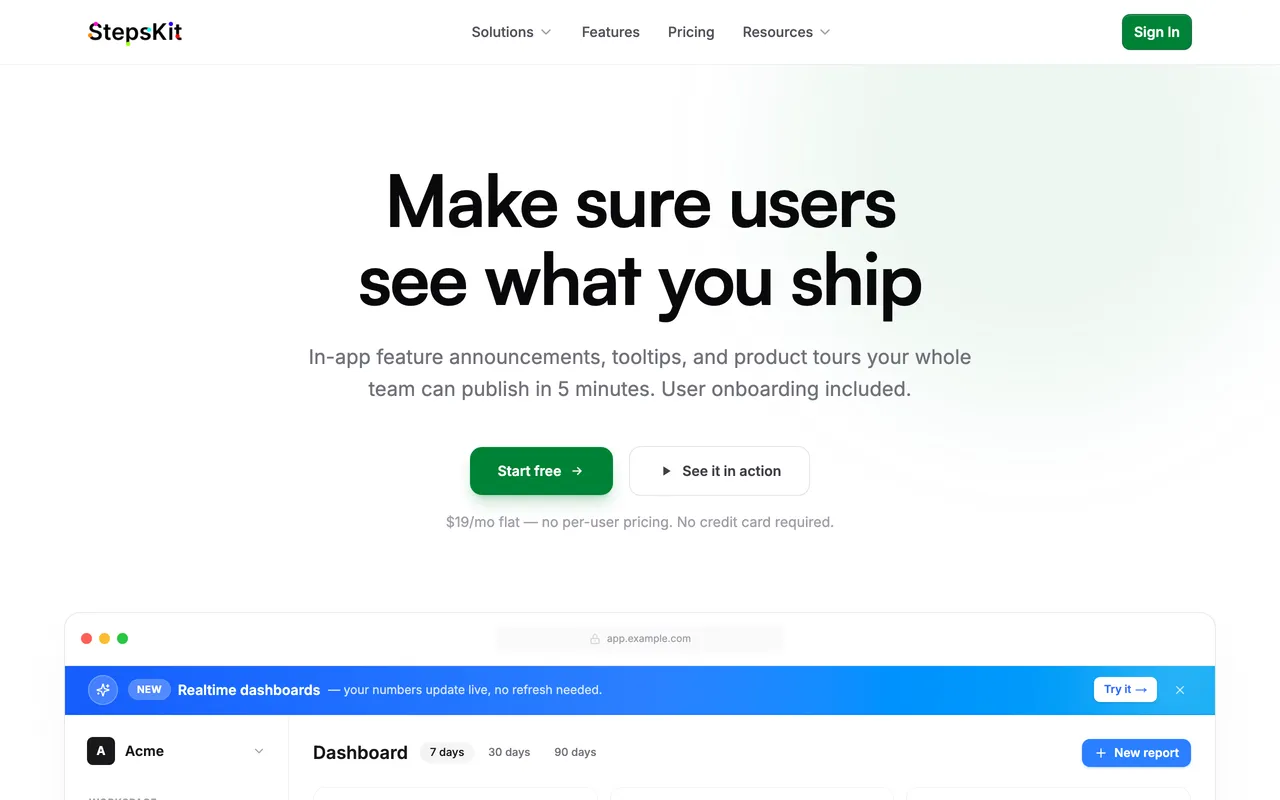
What it does well:
- Live in minutes — write, theme, target, ship, with no implementation phase at all
- Flat monthly pricing with no per-user licenses and no sales negotiation
- Step-level tour analytics built in, so drop-off is visible immediately
- AI content assistant for drafting step copy
- Audience targeting, page-level visibility rules, and brand theming included
- First tour is free — no credit card, no demo call
Where it falls short: it only covers your own web product — no third-party app guidance, so it can't touch Whatfix's employee-facing DAP use case; no native mobile SDKs; and no enterprise governance, SSO depth, or professional-services layer.
Best for: teams whose actual Whatfix use case was customer onboarding in their own web app, and who want it live this afternoon at a predictable cost.
The tradeoff: you give up the entire DAP surface area for speed and flat cost — exactly right when your product is the only app that matters, and a non-starter if employee apps are the job.
2. UserGuiding — best for approachable breadth, with a real free tier
UserGuiding covers most of the customer-facing experience set — tours, checklists, hotspots, surveys, a resource center — behind one of the easiest editors in the category, and it's the only tool here you can fully evaluate without talking to anyone: published pricing and a genuine free tier. Coming from Whatfix's quote-and-demo world, that transparency alone changes the evaluation.
The boundaries are clear, though. It instruments your own web product only, analytics stay basic, and the design ceiling is serviceable rather than deep. It meters on monthly active users, so cost grows with your product — gently at first, less gently at scale.
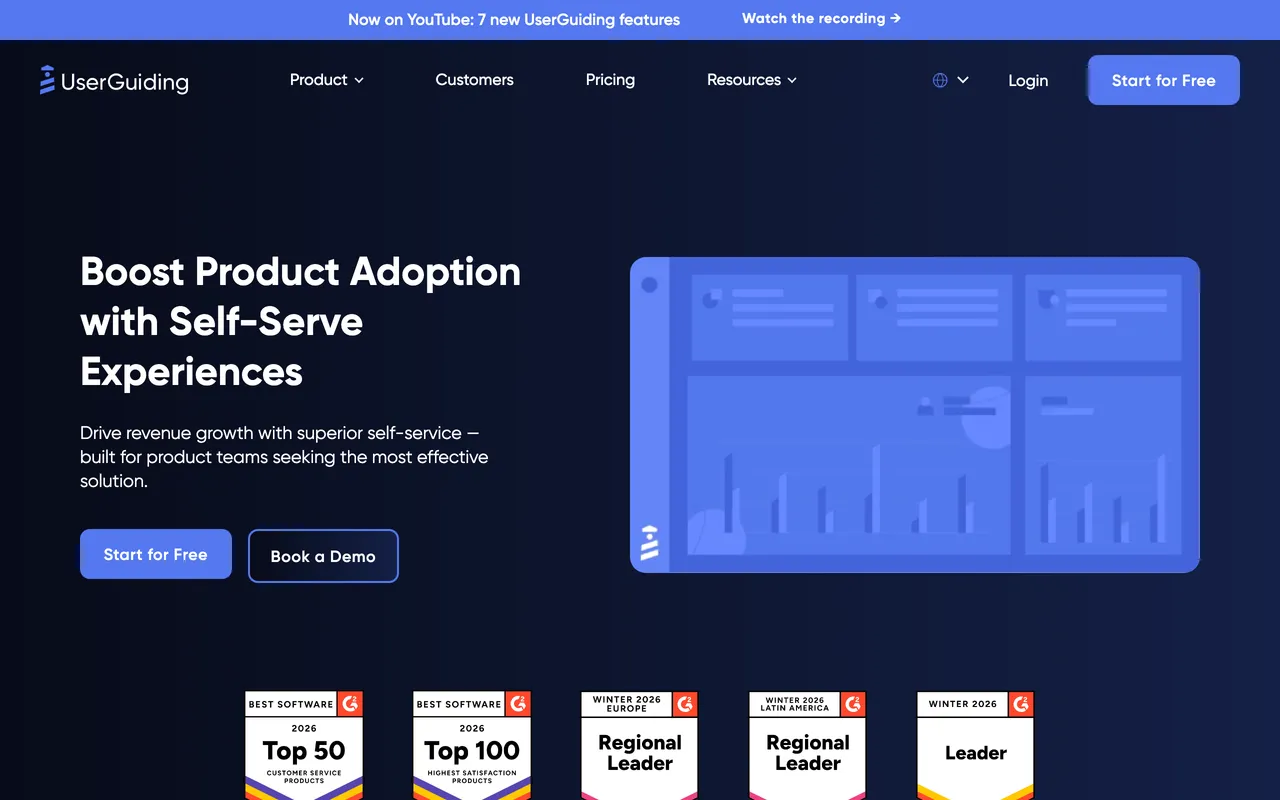
What it does well:
- One of the gentlest learning curves in the category — flows live on day one
- Published pricing and a real free tier — no sales gate anywhere
- Broad experience set: tours, checklists, hotspots, surveys, resource center
- Localization included
- Consistently high satisfaction ratings on G2 and Capterra
Where it falls short: web-only, own-product-only; analytics and segmentation are much lighter than Whatfix's; and per-MAU tiers climb as you grow.
Best for: small and mid-sized teams that want Whatfix's customer-facing breadth without the contract, the rollout, or the learning curve.
The tradeoff: ease and transparency in exchange for depth — a simple use case fits perfectly; a complex one will outgrow it. See StepsKit vs UserGuiding for where the entry plan stops.
3. Appcues — best for polished no-code with native mobile
Appcues is the category's original no-code builder (founded 2013) and still one of its most polished: a clean editor, mature segmentation, the deepest documentation in the space, and a long support reputation. Against Whatfix's engineering-flavored authoring, it's the tool where a product marketer genuinely can own the whole lifecycle — and it extends beyond web to native mobile, email, and push, so it covers lifecycle messaging as well as onboarding.
The catch will feel familiar: Appcues publishes no prices — every tier is "book a call" — so you trade Whatfix's quote process for another quote process, if likely a smaller number. And it's guidance-first: its analytics measure experiences well but won't replace a behavioral suite. We keep a separate roundup of Appcues alternatives for the mirror-image comparison.
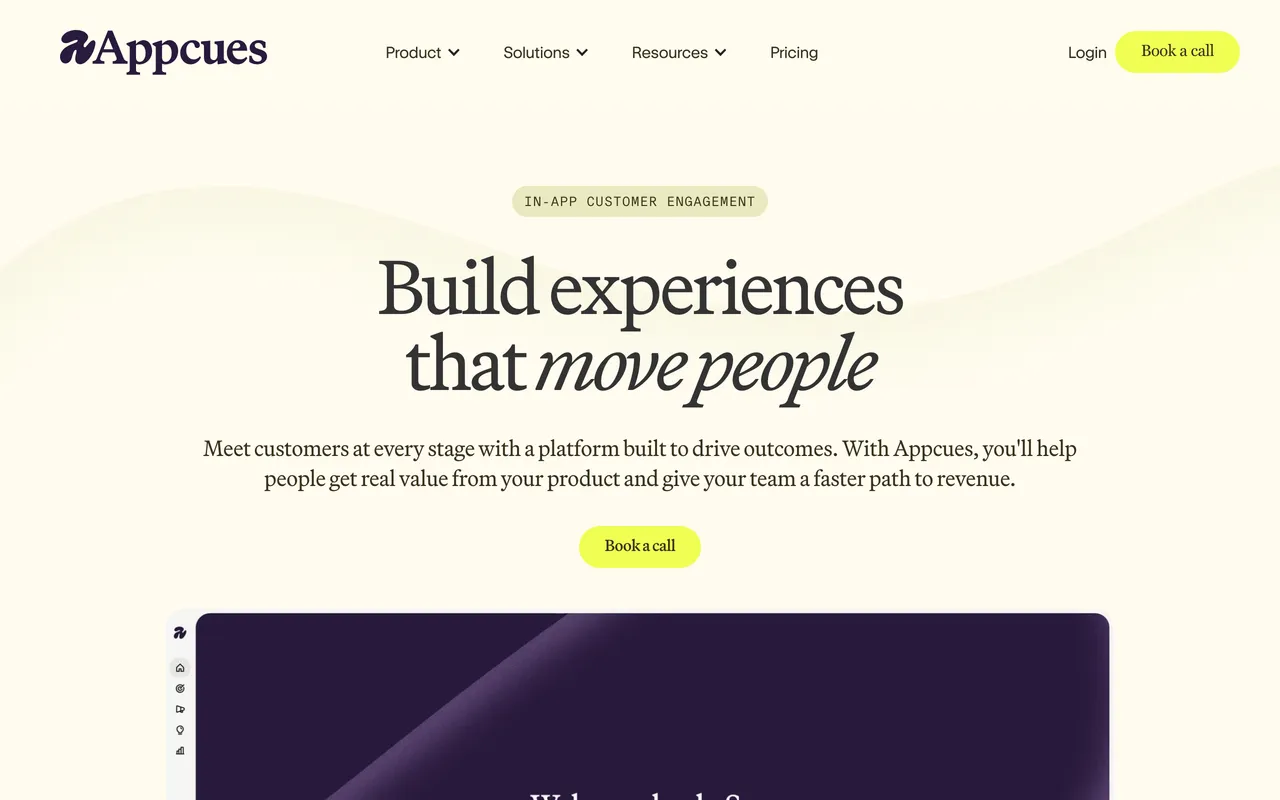
What it does well:
- One of the most polished no-code builders in the category, with a gentle ramp
- Multi-channel: in-app on web and native mobile, plus email and push
- Mature segmentation and event-based targeting
- The deepest documentation and a strong support reputation
- A large, recognizable customer base
Where it falls short: own-product-only — no third-party app guidance; opaque, sales-gated pricing; and analytics lighter than a dedicated suite.
Best for: product and marketing teams onboarding customers across web and native mobile who want the safest, best-supported no-code option.
The tradeoff: maturity and multi-channel reach in exchange for pricing opacity — a smaller sales conversation than Whatfix's, but still a sales conversation.
4. Userpilot — best for onboarding and product analytics in one
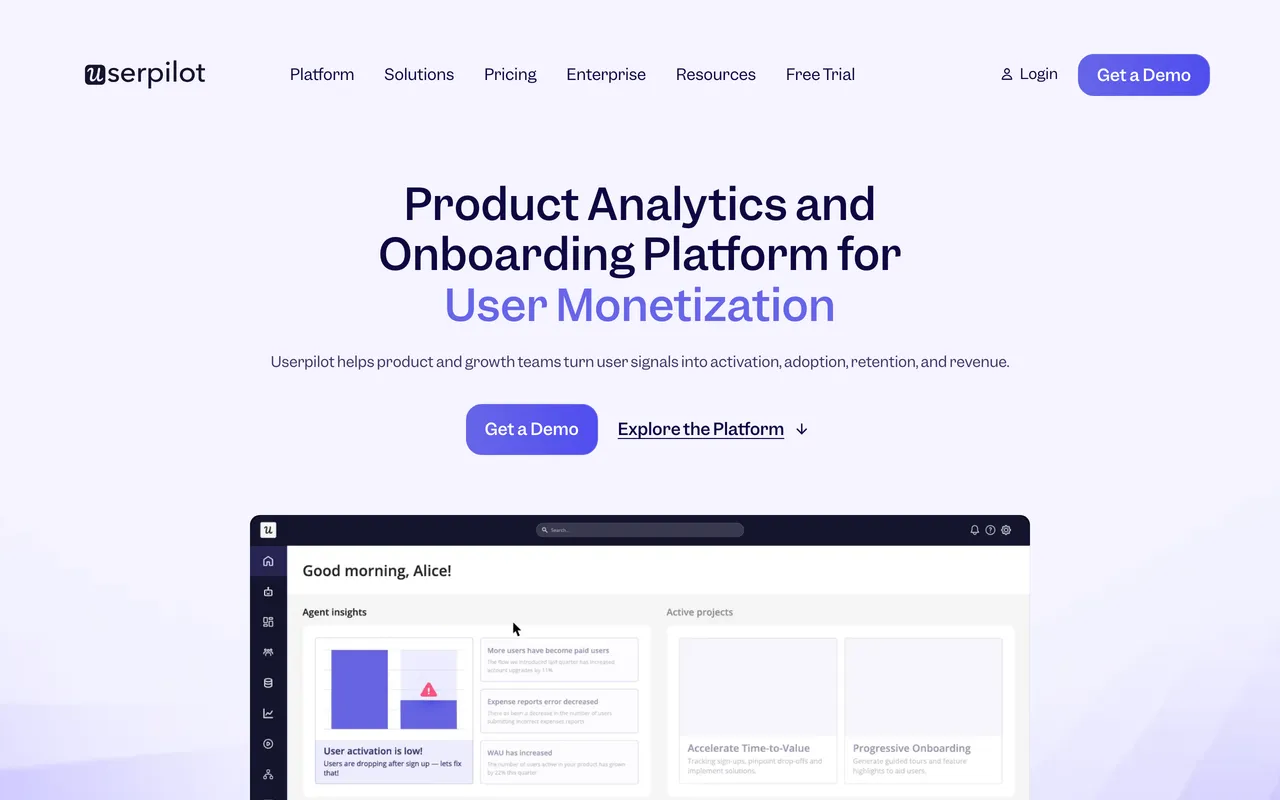
Userpilot consolidates flows, checklists, surveys, NPS, and genuine product analytics — funnels, trends, cohorts — into one platform for your own product. If part of Whatfix's appeal was analytics riding alongside guidance, Userpilot is that idea without the DAP machinery: you see what users do, then target flows at the friction, all in the same tool.
It's a mid-market platform with mid-market weight: the most-cited complaint is its learning curve, the published entry tier has a modest MAU cap before sales-gated tiers begin, and mobile and session replay are paid add-ons. It's lighter than Whatfix on every dimension — including the ones you might still need. There's a separate roundup of Userpilot alternatives for the reverse comparison.
What it does well:
- Genuine product analytics — funnels, trends, cohorts — alongside the flow builder
- Strong segmentation and event-based targeting
- Native NPS and microsurveys
- Published entry pricing, unlike Whatfix's quote-only model
- Native mobile available as a paid add-on
Where it falls short: a real learning curve of its own — the top review complaint; own-product focus, not third-party apps; and the useful depth lives above the entry tier, metered on MAUs.
Best for: mid-market product teams that want onboarding decisions and the data behind them in one tool.
The tradeoff: one consolidated platform in exchange for real ramp-up — you're adopting an analytics suite, not just a tour builder.
5. Userlane — best for employee guidance on internal apps, with less machinery
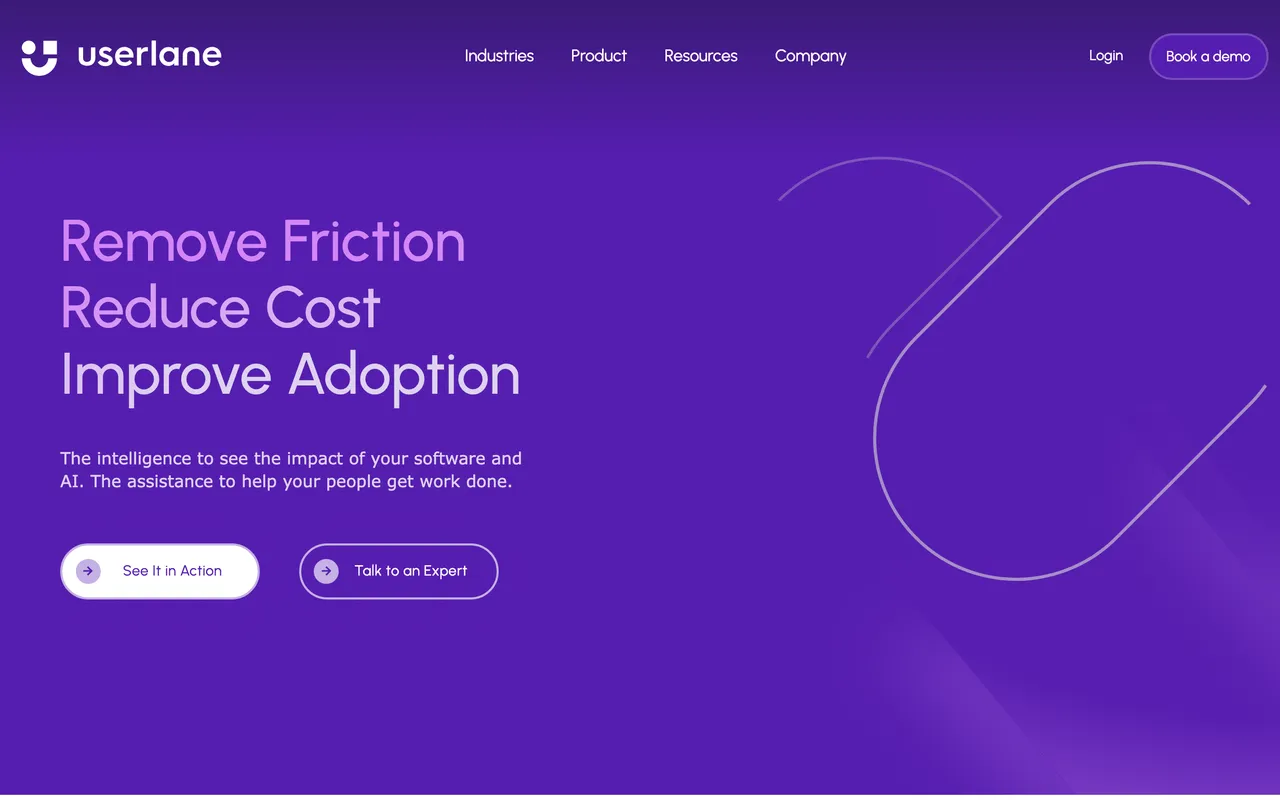
Userlane is the first tool on this list that competes with Whatfix at its own game: in-app guidance for employees across third-party applications — think onboarding staff into Salesforce, SAP, or a homegrown ERP. Its reputation is the approachable DAP: reviewers consistently credit an intuitive editor and faster path to live guidance than the heavyweight platforms, and its HEART-based adoption analytics surface where employees get stuck and what that friction costs.
It's still an enterprise product — pricing is a custom contract, and you'll talk to sales — but the contract and the rollout are typically lighter than Whatfix's. The boundaries: customization depth is more limited, and it's employee-adoption-focused rather than a customer-onboarding suite, so it's the wrong pick if your users are customers.
What it does well:
- True DAP coverage: guidance on third-party and internal employee apps, like Whatfix
- Consistently praised as more intuitive and faster to deploy than the DAP heavyweights
- HEART-framework adoption analytics to locate and cost employee friction
- Strong fit for HR/IT-led software rollouts and employee training
- Lighter implementation than the enterprise DAP norm
Where it falls short: custom-quoted contracts with no published pricing; customization depth trails Whatfix's; and it's not built for customer-facing product onboarding.
Best for: organizations that need Whatfix's employee-facing job done — software rollouts, internal training — with a gentler tool and rollout.
The tradeoff: a simpler, friendlier DAP in exchange for less depth and configurability — the right direction if Whatfix felt like more platform than your rollout needed.
6. Pendo — best for analytics-first adoption at scale
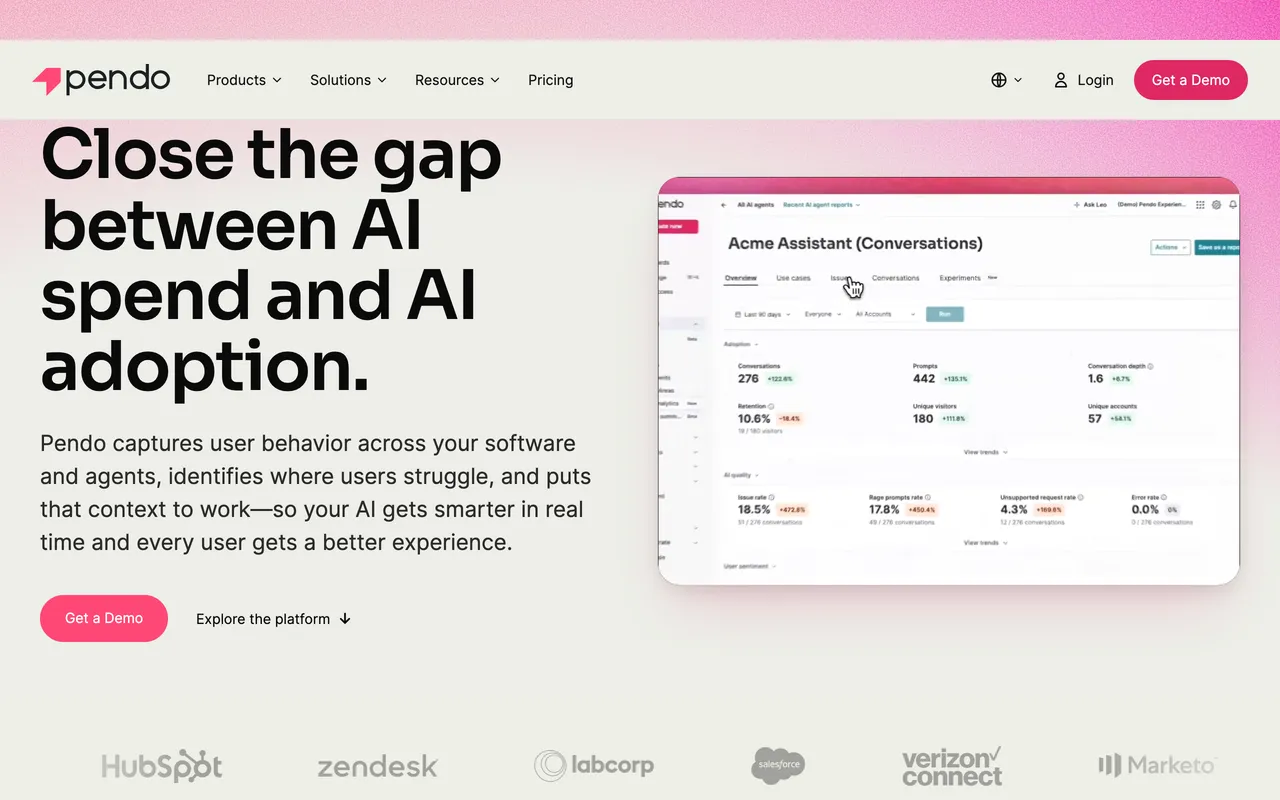
Pendo comes at adoption from the opposite direction: analytics first, guidance on top. Retroactive behavioral data that answers questions without pre-instrumenting events, session replay, NPS, and in-app guides across web, native mobile, and multiple products — one behavioral source of truth that Product, CS, and Marketing all work from. If Whatfix's analytics always felt like an accessory to the guidance, Pendo inverts that hierarchy.
It's an enterprise commitment of the same order: beyond a genuinely useful free tier, paid plans are custom sales-gated contracts, implementation runs in weeks with a dedicated owner, and guide styling beyond the basics tends to want CSS. For a deeper head-to-head, see the full Pendo comparison — or the best Pendo alternatives if Pendo itself is what you're weighing.
What it does well:
- The deepest product analytics of the group — retroactive, no event pre-instrumentation
- Session replay, NPS/sentiment, and in-app guides on one platform
- Native mobile and multi-product coverage
- A real free tier to evaluate with
- Scales to org-wide use across Product, CS, and Marketing
Where it falls short: own-product focus — it isn't a third-party-app DAP; every paid tier is a custom sales-gated contract; and it demands implementation time and a dedicated owner.
Best for: Series B+ organizations that want adoption guidance grounded in serious behavioral data — for their own products, including mobile.
The tradeoff: unmatched analytics depth in exchange for enterprise cost and rollout — a sideways move in weight, a different center of gravity.
7. WalkMe — best for a like-for-like enterprise DAP
WalkMe is Whatfix's most direct rival: the original digital adoption platform, now under SAP's roof, covering employee and customer guidance across web, desktop, and mobile, with workflow automation and deep adoption analytics on top. Organizations switch in both directions between these two — WalkMe generally reads as the more powerful and more complex of the pair, with a build experience that expects trained owners (and often certified admins) rather than casual editors.
Commercially it's the same world you're leaving: custom contracts, implementation measured in months, professional services in the mix. You'd choose it over Whatfix for depth — broader automation, more mature enterprise governance, the SAP ecosystem — not for relief. For the full picture, see the dedicated WalkMe comparison or the best WalkMe alternatives roundup.

What it does well:
- The most feature-complete DAP: employee + customer guidance, web, desktop, and mobile
- Workflow automation that goes beyond guidance into doing steps for users
- Deep adoption analytics and enterprise governance
- SAP backing and ecosystem integration
- Proven at very large enterprise scale
Where it falls short: everything that pushed you off Whatfix, amplified — custom contracts at enterprise prices, months-long implementations, and a platform that expects dedicated, trained owners.
Best for: large enterprises replacing Whatfix with more DAP, not less — deeper automation, governance, and scale.
The tradeoff: the ceiling of the category in exchange for its maximum cost and complexity.
How to choose
Match the tool to why you're leaving, not to a leaderboard:
- Whatfix was onboarding your customers in your own web app? → StepsKit for the fastest, flattest path; UserGuiding for more breadth with a free tier.
- Need customer onboarding across web and native mobile? → Appcues, or Pendo at enterprise scale.
- Want the analytics half to be real, not bundled-in? → Userpilot (mid-market) or Pendo (enterprise).
- The job is employee guidance on third-party apps? → Userlane for a lighter touch, WalkMe for maximum depth. Nothing else on this list does this job.
- Leaving over implementation weight and maintenance? → StepsKit or UserGuiding — the two with no implementation phase to speak of.
- Leaving over the contract, not the product? → The published-pricing tools: StepsKit, UserGuiding, Userpilot's entry tier.
When you don't need a Whatfix alternative at all
A section the affiliate-funded roundups skip. Switching tools is the wrong move when:
- You're mid-rollout on a fleet of internal apps. The painful months of a DAP implementation are a sunk cost; the payoff period is only starting. Migrating now re-pays that cost elsewhere for little gain.
- Your real complaint is one gated feature or the renewal number. Whatfix's editions are negotiable in ways self-serve tools aren't. A renewal conversation is cheaper than rebuilding every flow on a new platform.
- The guidance breaks because the underlying process is broken. If employees abandon flows in an internal tool, the workflow itself — not the guidance layer — is often the problem. No DAP fixes a process people are routing around.
- You genuinely need both sides — employees and customers — in one platform. Only WalkMe truly matches that combined footprint, and it isn't lighter. Splitting into two focused tools can work, but it's two tools to own.
- You're under ~50 users on a single internal app. A well-written runbook, a Loom, and a champion user cost nothing per month. DAPs earn their keep at scale, not before.
Bottom line
Strip away the category label and the decision is about which half of Whatfix you were actually using. If it was guiding employees through third-party software, your real alternatives are Userlane (lighter) and WalkMe (deeper) — the rest of the list doesn't do that job. If it was onboarding customers into your own product, you can step off the DAP entirely: StepsKit and UserGuiding for speed and transparency, Appcues for polish and mobile, Userpilot for bundled analytics, Pendo for analytics-first depth.
And if what you mostly need is customer onboarding live fast on predictable, flat pricing — no quote, no implementation project — that's the problem StepsKit was built for, and the first tour is free if you'd rather try it than take our word for it. Whatever you choose, match it to your team's reality rather than a leaderboard: the wrong-fit tool is expensive at any price.
Common questions
What is the best Whatfix alternative? It depends on which Whatfix you bought. For employee guidance on third-party apps, Userlane (simpler) or WalkMe (deeper). For onboarding customers in your own product, StepsKit for the fastest flat-priced path, UserGuiding for breadth with a free tier, Appcues for polished no-code with mobile, Userpilot for bundled analytics, Pendo for enterprise analytics-first adoption.
Is WalkMe or Whatfix better? They're the two ends of the same category. WalkMe is generally deeper — more automation, more governance, SAP backing — and correspondingly more complex and expensive. Whatfix is often credited with better support and somewhat faster time-to-value. Switching between them trades one enterprise DAP's problems for the other's.
Which alternatives avoid the implementation project entirely? StepsKit and UserGuiding — both are self-serve, live the same day, with published pricing. That's only possible because they do the customer-facing half of the job in your own web product; nothing that instruments third-party enterprise apps installs in an afternoon.
Can any of these guide employees inside Salesforce, Workday, or SAP? Only Userlane and WalkMe. That's the defining DAP capability, and it's the question to answer before comparing anything else. The rest of this list — StepsKit, UserGuiding, Appcues, Userpilot, Pendo — instruments your own product for your own users.
How do these compare on price? By model: StepsKit is a flat plan; UserGuiding publishes tiers with a free tier; Userpilot publishes an entry tier, then meters on MAUs; Appcues is sales-gated; Userlane, Pendo (beyond its free tier), and WalkMe are custom enterprise contracts — the same commercial shape as Whatfix. Weigh cost after fit; the wrong tool is expensive at any price.
Can I migrate my Whatfix content? No tool imports another vendor's flows — targeting and content models differ too much, and third-party-app selectors doubly so. Plan to rebuild. The silver lining: a migration is the natural moment to retire the flows that analytics say nobody finishes.
For the wider category beyond Whatfix's direct competitors, see our roundup of the best product tour software in 2026.